
Cuero Chupacabras Caught on Dashcam
Posted by: Loren Coleman on August 12th, 2008
New footage of a running “Chupacabras” – i.e., in this case, a mystery canid – has been caught on a dashboard camera by the DeWitt County, Texas, sheriff’s department. This occurred near Cuero, Texas, the new “capital” of Chupacabras activity since the “mystery canid” body was found there.
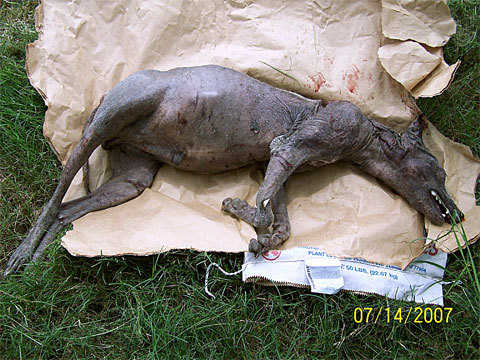
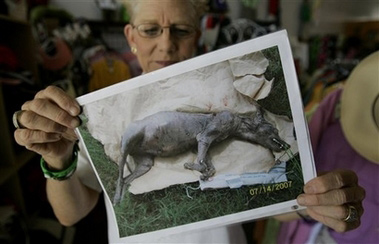
Contributed Photo: Phylis Canion
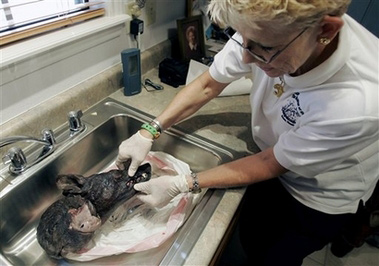
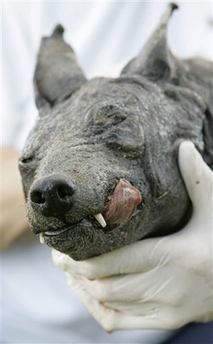
The DNA results for Phylis Canion’s find have not been accepted kindly by the local residents.
Here is a silent YouTube version from the local television station KENS 5.
The link to the tape, with audio, playing on CNN.com today is here.

There is also a new documentary being produced on the Cuero Chupacabras under the name “Texas Snipe Hunting.” Here is their “trailer”:
The dashcam video seems sure to seal the title of Chupacabras mecca for Cuero.
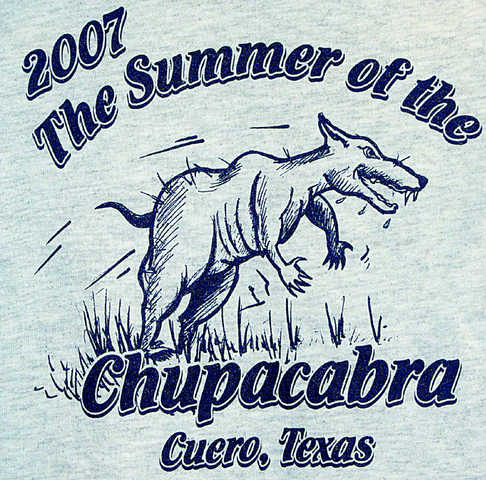
“Chupacabras: It’s sort of like Jennifer Lopez, kind of cross-cultural.” – Loren Coleman, as quoted by ABC News, 1999.
Why do I continue to call all of them, singular and plural, “Chupacabras”? If interested in the answer, click on “Chupawhat?”
 About Loren Coleman
Loren Coleman is one of the world’s leading cryptozoologists, some say “the” leading living cryptozoologist. Certainly, he is acknowledged as the current living American researcher and writer who has most popularized cryptozoology in the late 20th and early 21st centuries.
Starting his fieldwork and investigations in 1960, after traveling and trekking extensively in pursuit of cryptozoological mysteries, Coleman began writing to share his experiences in 1969. An honorary member of Ivan T. Sanderson’s Society for the Investigation of the Unexplained in the 1970s, Coleman has been bestowed with similar honorary memberships of the North Idaho College Cryptozoology Club in 1983, and in subsequent years, that of the British Columbia Scientific Cryptozoology Club, CryptoSafari International, and other international organizations. He was also a Life Member and Benefactor of the International Society of Cryptozoology (now-defunct).
Loren Coleman’s daily blog, as a member of the Cryptomundo Team, served as an ongoing avenue of communication for the ever-growing body of cryptozoo news from 2005 through 2013. He returned as an infrequent contributor beginning Halloween week of 2015.
Coleman is the founder in 2003, and current director of the International Cryptozoology Museum in Portland, Maine.










The documentary looks like it was made just to cash in on the hype. Why the he__ didn’t I think of that first?!!!
Dang!
Regardless of the fact that DNA results have come back as Cayote as well as Domestic dog and wolf cayote hybrid, something is not right. That is undeniable. On the recent (a few weeks ago) Monster quest episode about the Chupa’s, all the scientist agreed that they had never seen a skin disease like this. If it is mange it is new super form of mange never seen before. Overall I for sure think there is something up with the canine population of Texas be it a new disease causing bizarre behavior and severe skin deforamation. These Changes may be brought about by hyribization of domestic and wild or in conjunction with a new disease. The live footage is also great as it shows one of these chubas alive and in motion. As I said, something is up, that is undeniable.
So the DNA shows that these animals are coyotes, but clearly there’s a mutation there that hasn’t occurred elsewhere… that we know of. That, what 3 of these animals, plus the footage above all look identical means it’s isn’t just mange but something else. Something giving them that coloration and the strange teeth.
So is it a genetic anomaly like albinism? It’s still pretty interesting.
The difference in leg size is apparent in the way the animal runs. but I ask, “super mange”??? perhaps its is hairless because it is, a genetic trait not disease. The video tho on the freeze of the creature turning its head 52 seconds in, the color seems to change. The head and neck seem not to line up that well. maybe I am seeing things! Have you ever driven behind a canine species, how many need to turn their head to see if you are still there? and just in time for a great color changing photo? I believe in the Chupa but this video…….I think altered a bit.
Again, referencing the Monster Quest episode- they also noted that all the samples were not naturally hairless and at one time had hair. If it was a genetic trait maybe a canine version of human alopecia? And as for the head turning, my neighbors dog who i walk fairly frequently often turns her head to look back or at something else, so thats not to odd to me at all.
Definetly some kind of coyote/canid. Obviously occurring in the same county (DeWitt) as the one in Monsterquest, they have some sort of genetic issue. Most likely it is what it is…a mangy coyote. I live about 80 miles from Cuero and had a pic of one on my trail cam last year, and saw it twice while deer hunting….it was definetly a coyote with mange. (Guess i should have saved the pic and made some money)….anyone that has hunted has seen coyotes look back EXACTLY like the one in the video!
Unless chupacabra means “hairless, probably diseased and very pitiful canine,” then these photos are not of the chupacabra. The creatures featured here are dogs, folks.
Does not look like a coyote…
Could be a dog. Though I agree with SamuraiWannabe—that has got to be the biggest super mange I’ve ever seen.
Could be a dog, but I’m not knowledgeable enough to determine whehter it could positively be or not.
I do agree with a guy I know who told me yesterday…
What the “bleep” is that?
Maybe somebody tried to make a hybrid using mexican hairless dogs (xoloitzcuintle)
BTW—
Mystery_Man???
DWA???
Spinach Village???
What do you guys think of this??? I do have to agree with the sheriff…it does not look like a coyote. I’m not an expert on coyotes so I could be wrong. Dog??? More likely, but something about the whole mange ain’t right. When it turned its head I had a “heeby-jeeby” moment I wouldn’t normally get if it was a dog. That does not mean anything from a scientific point of view, I know. Just pointing out that the face looked very “strange,” almost pig-like. And I also know “dogs” who turn their heads to look at things too.
I just feel we need to be careful here. We can conjecture that it is a dog, sure, but until we get more information of the physical or “more detailed” kind we shouldn’t totally tag it definitely as a “dog” or “coyote.” Does it walk like a dog with a skin disease? Do coyotes have that type of stride? Etc. Etc. Etc. Good story.
Is there something about final stages of terminal mange infections that drives canids to become haematophages?
I can’t say yea or nay to “supermange” here in Tx, but that ~is~ a coyote running from the police car in the clip. The look over the shoulder is typical coyote behavior, and the profile is unmistakable, even without hair and neck ruff.
We have a lot of coyotes here, and often have daylight sightings. Coyotes will take off running flat out and glance back to assess the threat you pose…whether you or a dog is pursuing or whether you are raising a gun. They may even stop after a few hundred yards and turn to watch you if they don’t perceive an active threat.
My curiosity is roused by the fact the coyote didn’t dart off the road and into the scrub but continued down the track. Now that was unusual.
Whether it is a coyote or not, Maven, that face when it turned around gave me the creeps…
This has got to be the most aardvark-looking coyote I have ever seen.
Go figure.
I think there are really three things at play here.
First, the aspect ratio of this footage is very wide. If you scale it to a ratio more suitable for standard televisions, the elongated snout and leg-size of the animal appears more proportional for a coyote. In short, the footage is stretched too wide.
Second, at about 43 seconds into the video, you can see the officer adjust the focal length of the camera, creating an effect known in film as a dolly zoom. This makes the footage appear more orthographic than it really is – hence, things that are far away (the snout) appear at roughly the same distance as things that are closer to the camera (the hindquarters). Hence, the head looks enormous.
For an example of this effect, watch this video:
http://www.youtube.com/watch?v=Y48R6-iIYHs
Finally, the location of the footage is suspect – surely the first thing this sheriff thought when seeing an unusual animal was “chupacabra” – a reasonable conclusion to jump to when reports of the alleged animal have been made there recently.
These things are weird, there’s no doubt. But like Skookhuman, in my opinion these animals do not fit the descriptions of the Chupacabras that have come from witnesses in Mexico, Puerto Rico, etc. They describe something that does not resemble a familiar (to them anyway) animal. Many of these descriptions allude to a bipedal, hairy creature, or even a reptilian looking beast, and often include wings and/or dorsal spikes. I think anyone who saw one of these hairless animals photographed and filmed in Texas would unhesitatingly describe it as “dog-like,” at the very least.
All hairless animals look a little freaky (at least, the ones we are *used* to seeing with fur). Cats, dogs, whatever (remember Mr. Bigglesworth from Austin Powers?). And most do have wrinkles to some extent, unless they are extremely overweight–which isn’t likely in a wild animal. Add a little postmortem desiccation to that, and it will look extra wrinkled until it bloats.
I just want to know how the four foot, upright, “alien” chupacabra that were in the original stories have morphed over into these “uber mangy canids”?
saw footage a couple years ago when i was stationed a fort stewart of an attack on a chicken by one of these, looks the same, dark gray hairless qaudroped cannid, possible mutation or fungal induced behavior.
If chupacabras are supposed to be more like reptoid space demons with huge eyes, spikes, and sometimes batwings, wouldn’t these Texas creatures be more like the legendary hellhounds?
SamuraiWannaBe – hahaha – so maybe the cryptid is the organism causing the skin disease, and the name chupacabras should be applied to this micro-organism! 😀 You heard it here first folks.
cryptidsrus- I think what we see is a very hairless, very freaky looking, coyote. Not only is the stride and shape right for a coyote, but the DNA test results showed that it was.
Animals can look a lot different without their hair. It can be hard to tell what a hairless animal was at first, especially if there has been any kind of decomposition. Coyotes can look freaky sometimes even WITH their hair. They can have a very peculiar way of moving, turning their head, etc. I have no doubt that any animal without their hair and on top of that a skin condition or deformity could be mistaken for something strange and anomalous.
The skin condition looks strange, and the hairlessness makes it seem more mysterious than it is, but all of the physical evidence has pointed to this being a coyote.
It sort of looks like its hopping like a kangaroo. Weird.
I think that the alleged chupacabras that keep on popping up are just a new genetic mutation of a coyote. The bodies that were found to be coyotes with mange, sowhy wouldn’t this be the same?
That poor mangy thing. To me it is obviously of the canine family, whether it is coyote or a cross between a domestic and a coyote that I can not say.
But if the scientific community can run a species test on an Atlantic Grouper, why not run a species test on this animal in question?
That looks nothing at all like a coyote.
I would definitely say it’s a dog. Just cause it’s bald & scroungy doesn’t mean it’s got some weird form of mange either.
I think it’s possibly a Mexican hairless. Just either from poor breeding lines (which can cause many problems in anatomy to make it run funny) and/or scraped up from living outdoors.
For those who never saw a Mexican Hairless dog, here is one.
I think it looks very much like the ‘Chupa’.
CrimsonFox, I just looked at the photo you posted, if that is a photo of a mexican hairless (No offense, just a wee bit skeptical these days..), I would would have to agree with you that it does more closely look like a hairless than mangy coyote.
CrimsonFox- The reason some might think it doesn’t look like a coyote is because of the lack of hair. I wouldn’t be too quick to say it doesn’t look like a coyote, a lot of animals look completely different without hair. The thing in the video could definitely be a hairless coyote. It looks weird because of the hairlessness, but I’m fairly certain that is what it is. Also, coyotes are not rare, in fact they are a nuisance animal. Mexican hairless dogs are not all that common or cheap. Why would there be a few of them out loose running around? Besides, the reason it looks like a Mexican hairless is because those dogs are always seen without their hair, it is expected. Coyotes are not. So I can see where the reaction could be to liken a hairless canine to a Mexican hairless dog, something familiar. But that doesn’t mean a dog is what we are seeing here. Everything fits with a coyote just fine except the hairless condition.
Besides, the body pictured had DNA tests done on it. It was a coyote. I’d say there is lots of evidence pointing towards coyote. Very little towards Mexican hairless.
I used to have a Chinese Crested dog.They are very similar to the Mexican Hairless breed, and I can say this dog definately looks like one of these dogs. They have odd shaped bodies,wrinkled skin,patchy..if any..fur, and their mouths are often deformed due to dental problems or a complete lack of teeth. They have odd, long slender legs, and sometimes protruding bellies. I am convinced what we have here is one of these dogs, or a possible mixed breed of one.
I still don’t get why so many people think these are chupacabras. They’re clearly canines, in fact they look like the breed known as Xolos. Which explains the hairlessness and bad skin. It’s someone’s lost pet that died.
NecrochildK thanks for having some knowledge and sense. It is a Xoloitzcuintle or at least a Xoloitzcuintle/Coyote hybrid (as it has been said it tested positive for coyote DNA).
The real chupacabras or “goat sucker” is no more than the vampire bat, however being the Mexicans that we are we thought it would be fun to make up a story to scare little kids like the many Aluxes, Lloronas and Ixtabais that tormented me as a kid.
lol And the legend ran wild with tourists, huh? Over here in Louisiana we have the loup garou, but it’s all but faded out. Though in all honesty, I do believe I’ve seen it when I was younger, my cousin as well. My grandfather and his family would see feu follets when he was a little boy, balls of fire that would come out of the forest and follow them in carraige or on horseback.
I’m guessing that this dog breed, Xoloitzcuintli, mix with some kind of wolf breed. This Mexican dog breed is identical. According to the American Kennel Club website, the breed’s name is pronounced “show-low-eats-queen-tlee”. The Xoloitzcuintli (Xolo, for short) is a a sensitive breed of above average intelligence and devotion. They are protective, but will meet aggression, rather than instigate it, taking their cues from their master’s uneasiness of a situation or person. Xoloitzcuintli are still primitive to some degree and need to be guided by reason and respect, rather than force of will. Though the Xoloitzcuintli is known as a hairless breed, litters often contain pups that are fully coated. Because the coated pups have traditionally been destroyed at birth, there is no standardization in coat color. This perhaps, has led breeders to believe that the coated pups are mixed breed puppies. A short course in genetics will disprove this belief. The coated Xoloitzcuintli has a short, course coat that sheds minimally. The coated Xoloitzcuintli is recognized by the UKC. The breed has a sleek body, almond-shaped eyes, and pointed bat-like ears. They look very similar to the Pharaoh Hound. Xolo come in three different sizes: Standard, Miniature and Toy. The biggest of the varieties are more likely to act as a guard dog than their smaller siblings.
it is NOT a chupacabra it is a hairless xoloitzcuintli!!!
i saw one at the dog show and i was like oh crap its the resident evil zombie dog!! and i talked to the guy and he was like its a xoloitzcuintli (pronounced it like shuli cuili) and its found in mexico. and i was like oh my god the chupacabra legend!!!cuz ya know wild dogs eating goats or chickens wouldnt be that strange! and sure enough heres stories of the DOG being killed because ignorant YES ignorant people dont have the mind to look it up! it has the shape of a canine you artards! i pet it, its skin was rough and wrinkly like a hide, and it wasnt evil it was all chill walking around like whatever. poor things :[[ people are killing it because it looks different but it can be domesticated and there are even some found with hair. STOP THE MURDER AND SPREAD THE WORD!!! stupid sheriffs.