
Bigfoot Contactees
Posted by: Loren Coleman on June 26th, 2010

Whether you call them Sasquatch contactees, Bigfoot magnets, Forest Giant abductees, or Wild People habituators, it is clear a new collection of people are to be reckoned with in hominology. What do you think of this modern trend?
Here is a flashback posting from March 4, 2007, which touched on this topic. What are your thoughts?

The image above may be enlarged by clicking on it. Janice Coy is shown by the Russian artist Lidia pulling out hair from the hand of the Carter family-named “Fox,” when giving him some garlic. March 2004. This montage was created by Lidia using Igor Bourtsev’s photograph of Coy with Bourtsev as the stand-in for Fox. Coy says she recreated the interaction while standing in the same dress and position as then. After the first draft drawing, Coy corrected Lidia several times until the artist achieved the correct graphic similarity to the events, as claimed by Coy. Used with permission from Bourtsev.
In March 2006, a Tennessee Bigfoot video was posted and discussed by Craig Woolheater here. [The links to the video are dead, unfortunately, and appeared to have been pulled.] The video was associated with the two main characters in this tale, Mary Green and Janice Coy.
The background to the videotape was that the Coy/Carter family claimed they have been in communication with a Bigfoot family for over five decades. Many in the Sasquatch studies community feel the very nature of this claim brings discredit to the entire science of hominology, especially without firm proof after all these decades. What do you think?
A few years ago, Craig Woolheater and I were discussing the similarity among people within a group of individuals whom he calls “Sasquatch magnets.” Craig has a specific definition in mind for the personalities he feel can be identified thusly:
There are a lot of people that would lead you to believe that they have repeated encounters with these creatures. I’m talking about people who make claims of going into the woods and finding tracks, often numbering in the hundreds, hearing mimicked vocalizations (most often owls) or seeing these things….every time they go out. I want to be clear here, I’m not talking about habituation cases. I’m talking about continual chance encounters.
(Although “habituation” is less frequently used that “habitation,” I’ll use “habituation” throughout this blog, to follow Craig’s initial use of the word here in this definition of his. Perhaps “habitation” versus “habituation” is the topic for a long discussion too, but back to Sasquatch magnets and Bigfoot contactees, for now.)
Craig sees a distinctive difference between these “Sasquatch magnets” and the habituation cases. I think they are only different points on a continuum.
After I got over my initial shock that Craig wasn’t discussing those funny things that look like tiny, tiny Bigfoot tracks that people put on their refrigerators (yep, I have some on mine), I began to focus on his content. These kinds of magnetic folk have been around a long time, and since the 1970s, I’ve been collecting their stories and classifying them as “Bigfoot contactees.”
In my 2003 book, Bigfoot! The True Story of Apes in America, I even wrote about two sinister and really atypical Bigfoot contactees named Charles Starkweather and Cary Anthony Stayner. Beside seeing Bigfoot routinely, both Starkweather, in the 1950s, and Stayner, in the 1990s, additionally, were serial killers. (The later murderer, the so-called Yosemite Killer, even wrote me from prison in 2006, and sent along his drawings of Bigfoot, which I included in the Bates College / Kansas City Artspace cryptozoology exhibition.)
Who is on your short list of Bigfoot contactee serial killers?
Meanwhile, all kinds of people have been labeling each other with the “contactee” moniker.
Maryland Bigfoot researcher Mark Opsasnick called the late Washington State Bigfoot tracker Paul Freeman, a Bigfoot contactee.
Bad Boy Erik Beckjord called Jack Lapseritis, a Bigfoot contactee. (No telling what Lapseritis called Beckjord.) Many people have called Beckjord a contactee, especially after he said “he” was Mothman because his out-of-body experiences were seen and identified incorrectly (?) as Mothman. We don’t even need to tick down all the Bigfoot 4D claims he’s made to put Beckjord in the contactee file. Or his pre-death media firestorm he created saying he had taken psychic photos of the late Nicole Simpson and Ron Goldman.
Jack Lapseritis in his book, The Psychic Sasquatch, spends his time discussing interviews with several Bigfoot contactees. (You don’t want to hear what the late René Dahinden called Lapseritis.)
Ken Dashow, host of the radio program, “Edge of Reality,” called Pennsylvania resident Stan Johnson, a Bigfoot contactee, after Johnson said he had been in touch with both the Heaven’s Gate suicide victims (after they killed themselves) and the “Seven Races of Bigfoot.”
“Jan Klement”, an elusive character in Pennsylvania hairy hominoid history, has to be termed a Bigfoot contactee.

(2010 note: Needless to say, Autumn Williams now has added this collection of stories by talking of “Mike” in her book, Enoch.)
What names are on your list?
Nowadays, there’s a whole group of folks claiming Bigfoot habituation, the sometimes seemingly permanent mutual living arrangement between the humans and a family or group of Sasquatch close to a rural setting or in a nearby woods. The humans are merely the latest group who, for all practical purposes, are the ultimate Bigfoot contactees.
Thom Powell’s folksy book, The Locals: A Contemporary Investigation of the Bigfoot/Sasquatch Phenomenon, is a study in habituation, and straightforwardly supports the tales from what can loosely be called Bigfoot contactees.
Are these merely just new outrageous, unsubstantiated claims regarding frequent sightings of Bigfoot wearing new clothing of the old 1970s’ Bigfoot contactees? Opinions vary. Powell is in a growing school of followers who doubt the mainstream Bigfoot theories and thoughts, as expressed by most chroniclers of Sasquatch and Bigfoot encounters and history.
Craig Woolheater has pointed to this part of what John Green has to say about such claims:
There is nothing new about people claiming that they have been able to make detailed observations of Sasquatch and know all about their appearance and behavior. People with stories like that have turned up numerous times in the past 45 years, and so far the end result has always been disappointment. If you are involved with such a person, be cautious. I have watched former colleagues get so deeply committed and then so sharply disillusioned that it soured them on the whole subject and they dropped out.
Similarly there is nothing new about people believing they see or hear or smell evidence of Sasquatch presence almost every time they go out in the woods.
But unidentified sounds and smells are just that, unidentified sounds and smells, and shapes found in photographs that could be Sasquatch could also not be. There are other agencies besides Sasquatch that can take food, make beds of vegetation, break trees and branches, move rocks, pound on things or make interesting depressions in the ground.
There have been cases where people have gone far beyond any reasonable extreme to fool someone with manufactured evidence of Sasquatch presence, and also cases where people have gone pretty far to fool themselves. Try not to add to that list.
All of us surely hope that some day some such story will be proved to be true, and at my age I tend to wish very hard that it will happen soon, but my experience offers no reason for optimism. Many years ago I decided that people who saw so much and knew so much were a long way ahead of me, so they had no need of my help and I would just await definite results. I am still waiting.
For anyone hoping to persuade mainstream science to take on this quest and provide the expertise and resources to bring it to a conclusion, episodes of this sort do real harm. Those who take them seriously end up looking foolish, and the prospect of looking foolish is surely one of the main reasons why few of the scientists that we know have an interest in this subject do anything about it, and why there is no financial or institutional support for those that do take it up. – John Green
Of course, the longest running, most accepted Bigfoot contactee story would have be the Albert Ostman encounter in 1924, where Ostman claimed he was kidnapped by a male Sasquatch and taken in his sleeping bag back to the Sasquatch’s canyon-enclosed campsite. Remarkably, there’s general agreement among many of us about Albert Ostman. John Green, Mark A. Hall, Ivan T. Sanderson, myself, and many others support and consider the Ostman story one of great merit.
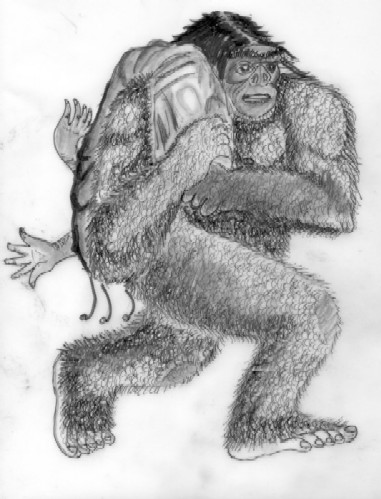
This is an interpretation of the Albert Ostman kidnapping by French hominologist Christian Le Noel. Used with permission from Le Noel.
Ostman’s continuing longterm event contained far more details than momentary observations of random meetings with Sasquatch. That no one else has observed Sasquatch females gathering food, or living in family groups on the scale detailed by Ostman is not a good counter argument to say there is no reality to the Ostman sighting.
A few of the Bigfoot contactees and habituation stories may turn out to be true, and some do contain elements that confirm the Albert Ostman story. But then again, all of the post-Ostman Bigfoot contactees could be making up their tales based upon Ostman’s descriptions – and combinations of elements from many other stories. It’s really difficult to tell until there’s a Bigfoot in hand, so to speak, and it is a verified species. Someday we may all look back and exclaim, “Oh, that’s what they were talking about!”
Until that discovery, the file of Bigfoot contactees goes. Who else would be on your list of Bigfoot contactees?
What do you think of this entire topic?
 About Loren Coleman
Loren Coleman is one of the world’s leading cryptozoologists, some say “the” leading living cryptozoologist. Certainly, he is acknowledged as the current living American researcher and writer who has most popularized cryptozoology in the late 20th and early 21st centuries.
Starting his fieldwork and investigations in 1960, after traveling and trekking extensively in pursuit of cryptozoological mysteries, Coleman began writing to share his experiences in 1969. An honorary member of Ivan T. Sanderson’s Society for the Investigation of the Unexplained in the 1970s, Coleman has been bestowed with similar honorary memberships of the North Idaho College Cryptozoology Club in 1983, and in subsequent years, that of the British Columbia Scientific Cryptozoology Club, CryptoSafari International, and other international organizations. He was also a Life Member and Benefactor of the International Society of Cryptozoology (now-defunct).
Loren Coleman’s daily blog, as a member of the Cryptomundo Team, served as an ongoing avenue of communication for the ever-growing body of cryptozoo news from 2005 through 2013. He returned as an infrequent contributor beginning Halloween week of 2015.
Coleman is the founder in 2003, and current director of the International Cryptozoology Museum in Portland, Maine.








I see no reason habituation can’t take place. But I also can’t believe that people can be in contact with the Sas for years and have no evidence of their existence. Where are the stray hairs (as an adult male I lose head and body hair all the time; these people never sweep up after Bigfoot?), where are the scat samples which could contain DNA, where are the surreptitious photos and videos, the nail trimmings, the many footprint castings? Cameras and video recorders are getting so small and inexpensive that some habituator somewhere ought to be racking up hours of photos and videos. Where is it?
Please don’t tell me that the Sas are all so shy and camera loathing that they can’t snap a few frames. If they are that shy, they would never become habituated and besides, I’ve had dogs that loathed the camera and others that absolutely loved it and would literally pose for the camera. If there are this many Sas around becoming accustomed to human presence, it seems that at least one of them would be a show-off (see humans, chimps, gorillas, bonobos, orangutans, many species of monkey, dogs, cats, horses, goats, you see my point…) everything has a percentage of individuals that crave attention. Where are the habituated Bigfoot Bonzos?
When the people who interact with the Bigfoot on a regular basis produce some convincing evidence, I’ll listen. But the “Oh, we can’t get any of those samples or evidence because it would be taken as a sign of bad faith (or fill in the blank),” is a dodge my granddaughters would consider naive, and they’re four and seven. Get real, people. Evidence!
All these “habituation” stories reek of “I’m closer to nature than you…blah, blah, blah”. I’m with Graybear. E-vi-dense! None of this “they’re shy” or “they can sense the inner workings of electronics” crap either. It is hard enough to get research into sasquatch legitimized without these types of outlandish claims.
I consider myself lucky to have seen this creature twice in the past three years. If I could afford to be out more, I’m sure I would see them more often. Always near rivers and lakes close to human activity, and very woodsy. They love the Piney woods and tall grasses that sprout from water bodies. I only really know of the situations in N.E.Texas and Oklahoma.They are out there. If you want to see one ya have to go out there for several nights, make a commotion and bring out the “smells” to attract them (Bacon). I’ve been out several dozen times and only two sightings. Go frequently and stay up all night and deal with all the other creatures. Remember, they are far more scared of us and the devices we carry.
I just wanted to point out that Autumn Williams isn’t really a bigfoot contactee, I believe she has only had one actual sighting, but she did just recently write a book called “Enoch” about a man in Florida who claims to have had multiple encounters with these things on a regular basis, making him a bigfoot contactee.
Hummmm, Like everyone else, habituation is possible, whether it actually happens or not is up for debate. Some of the accounts I’ve read have more plausibility than others. Not having ever met the people claiming such encounters, I think once you have you can tell whether they are articulate or creative enough to confabulate these tales.
However, I will say this, people see what they want to see or expect to see. I stood 5 feet off a trail once waiting on my family to catch up so others walking by could get past me. I was amazed that no one noticed me. Why? Because they aren’t expecting to see a grown woman standing in the bushes in the middle of no where. Things can hide in plain sight.
On the other hand, there are people who think he is always around because they misinterpret what they here and see in the woods. I have no idea why it would be preferable to have 8-9 foot tall wild man roaming in your woods as opposed to a herd of deer, but there you have it.
Then are people like me who have things happen, try to find a logical explanation, and can’t. If bigfoot exists he probably has different temperaments just like any other animal or human. Maybe there has to be some kind of commonality to exist there before a relationship is established across species. Not all humans jive with all horses or dogs, and vice versa.
Bigfoot “Contactees?”
Just my humble opinion and selective memory, but I can’t think of a more destructive trend for those truly interested in cryptozoology as a science. Whenever spiritual, supernatural or paranormal elements are ever injected, and with good reason, serious scientists scramble for cover.
You wonder why serious scientists dismiss cryptozoology as a “science?”
Well, people like Autumn Williams certainly won’t make it any easier.
Habituation claims are not necessarily false: a North American ape would likely get used to people here and there, and if people could get chimps and gorillas to accept their presences, the same hting could presumably happen with sasqautch.
But the taint of unverifiable calims reminds me of the old UFO contactee stories: some of them involved seemingly sincere people, but none of them involved evidence.
I have yet to read of a sasquatch contactee offering a plausible reason for not collecting photos, hairs, etc. and providing them for scientific examination. If sasquatch is real, it’s an animal that needs protection: protected habitat, antihunting laws, etc. It can’t be protected if we don’t know it’s there. Keeping it secret is not going to protect it from habitat loss and other pressures.
I realize no contactee has an obligation to provide a reason that satisfies me: they only need one that satisfies themselves. But will science ever take the animal – or cryptozoology – seriously with these kind of tales given credence if there is no supporting evidence? No.
I’m the same as most others. I don’t believe any of these people who tell of such repeated encounters if they have absolutely no evidence whatsoever in support of their claims. It’s one thing to have no evidence of a one off encounter that’s fleeting but having multiple ‘habituation’ encounters and still no evidence? Nope, sorry I don’t buy it. There’s probably some psychological problem going on there or (more likely) they are out to tell a few tales. Lots of people make stories up.
What load of crap! There would be a substantial amount of evidence of “habitation” ala physical proof if such a thing really was occuring and could easily be proved because of the abundant evidence left behind. Foot prints,hair,scat,dna,ect… The things people will do or claim/say to feel special or try to grab celebrity is unreal!
I’m skeptical for a couple of reasons. One, I talked to a man once who was convinced that he was an “invisible fairy” contactee. No joke, he was actually convinced that he had ongoing contact and relationships with invisible fairies. Not only did he sound convinced, he sounded convincing. He didn’t come off as crazy or unbalanced in any way. He even claimed to have pictures. When I asked to see them, he said it wouldn’t do any good because he was the only that could see the invisible fairies in the pictures. It seems, you have to know what to look for. I suspect the same thing may be going on with Bigfoot contactees. They actually believe what they are seeing.
Two, my experience with BF contactees has been limited to the internet, but they all seem to have a problem with clearly expressing themselves in message posts. They aren’t very lucid online. And they all seem to think that BF is something other than natural.
That having been said, I haven’t read Enoch. I can’t comment on the book. I do look forward to reading it.
Sounds very much like the “invisible fairy” contactee was in fact “off with the fairies”…
I used to watch Autumn Williams TV show “Mysterious Encounters”.
She never turned up any solid evidence, they just would keep going to commercial break with cliff hanger after cliff hanger trying to make you think they finally found something, only to get you to keep watching.
This is the same old crap. Give us some proof already. Does she really expect people to just accept that she talks to some guy named Mike that lives with a Sasquatch?
She seems like one of the Tom Biscardi’s of the bigfoot research field. Maybe Biscardi was serious at one point, but somewhere down the line he gave up or stopped believing, and then he was in it just for the money opportunities. If she really wanted us to believe her and believe this guys story was real, she would release this book online for free. Just reeks of a money grab opportunity to me.
Step 1: Make up a story about a guy that lives in a swamp and talks to bigfoot
Step 2: Spin it as a real story
Step 3: ????
Step 4: Profit!
“Contactees?” Please, give me a break, this is George Adamski territory folks – Google him if you don’t know who he was. This is pure nonsense propagated by people with some psychological need for attention.
From a strictly sociological POV, it seems that these stories about Bigfoot contactees have the potential to significantly alter the field of cryptozoology, the same way Ufology was altered by the tales of alien abduction that began to surface in the 70s and 80s.
In those years the ‘serious’ UFO groups avoided those tales like the plague; and the outcome was disastrous.
That doesn’t mean the tales of Bigfoot habituators or alien abductees are necessarily true; what I’m trying to point out is that pretending those stories don’t exist and/or pleading folks not to pay attention to them is not the greatest of policies.
On an aside, a couple of people have mentioned DNA on this post; I’m one of them. To be fair about it, since there is no recognized Bigfoot DNA sample in existence, it would be really tough to provide a match for it. There is no nucleotide sequence which has “Hey, I’m a Bigfoot sample! Were you lookin’ for me?” written on it. There are, however, nucleotide sequences which are known to be of primate origin. If one or more of the habituators should come up with a hair or scat sample (which often contains DNA) that tests out as “Primate, unidentified species,” and it has been tested against human, gorilla, chimp, bonobo, orang, as a good laboratory should do, I would accept that as strong evidence. Especially in Tennessee or in Texas, neither of which is exactly prime primate habitat (except for us hairless apes).
Sure, why not. Something is going on. This blonde lady looks like an elf, like someone Dion Fortune would say had a direct contact with the elemental world.
I think Sasquatch (and his various related forms) is quasi-biological, a semi-spirit Being. He is seen as an omen and harbinger among most us natives. The Big Man, a guardian of the wilderness, a guardian of the threshhold between worlds. As Patrick Harpur said, he is part of Daimonic Reality, part of the fabric of reality. An expression of Hansen’s Trickster. A child of the great god Pan (notice in twilight language “coincidence” that the chimp is Pan troglodytes?)
Yes, biological in many ways, but not like a chimp or okapi. His “evidence” is real..but the same evidence is always shifting in the very act of seeing and witnessing into ambivalence. And these people who are contacted, well, most are marginal themselves. Like Trickster, a little shady and/or a little loopy, walkers on the threshhold meeting a guardian of the threshhold.
It’s like water. The tighter you squeeze it, the more it squirts from between your fingers.
When you consider the substantial increase in human population in conjunction with the advancement of communication technology, sighting and reporting a previously unknown creature becomes all the more likely.
It has taken decades of serious research by serious men and women to elevate cryptozoology above the UFO/Supernatural crowd to what it really is: Scientifically sound study and research of undiscovered ANIMALS.
Now, is habituation/habitation possible? Yes. Dian Fossey and Jane Goodall prove that.
But they shared with the world what they found. They fought (and Dian Fossey died) to protect what they learned.
But this is a joke. If you have Bigfoot in your backyard: prove it or go away.
It is hard enough to begin to convince persons that there is a possibility of an unknown animal out there, without fairy tales/lies/hallucinations.
Cryptozoology has really received better than expected treatment over the past 5-10 years. The hard work of Loren Coleman, Karl Shuker, Matt Bille, and many others made it possible.
These Spirit Guardian of the Forest crowd are going to be the undoing of all this work.
Sorry if it seems I am ranting.
Everybody wants to feel special.
Some people are so in need of this that they convince others and themselves of improbable stories in order to get the appropriate attention. This is not to call anyone liars, just human beings being human. I personally know people like this and I sympathize. But I don’t believe their ridiculous stories whether it be UFO abductions or so-called spiritual experiences. They have no problem with my “scepticism” as long as I treat them as fellow humans.
Today it’s bigfoot, yesterday it was intergalactic messengers, and before that we had visiting angels and deities. What does Occam’s razor yield? Human needs.
I do believe in bigfoot as a physical animal, though, without feeling that I’m stretching it. I’m also willing to see that statistically it’s possible (even likely) that one really weird person may have regular contact with such a being. But I wouldn’t count anything intangible from this person as evidence of anything but their need for attention.
I was under the impression Pan was the spirit gaurdian of the forest. At Least that what Mr. Badger said in the Wind in the Willows. I still hold that if Bigfoot and company are for real that they are North American Moutain Gorillas. That in itself would be cool as hell.
I read the book and didn’t get the spiritual, supernatural, etc….aspect that some are criticizing. It was pretty bland and straightforward. Nothing truly fantastic in the book is revealed if you lean towards the theory of bigfoot being close to human. There were a couple of incidents that might border on extra sensory perception but that was just an impression that “Mike” had, assuming he exists. It would not have been a book had Autumn not filled it in with her thoughts and perceptions. She spends a good bit of the book saying the same things everyone else has said about not providing proof. I’m not quite sure where the forest friend stuff came from, Enoch as described by “Mike” was anything but that in my opinion. I am not clear on why this hurts cryptozoology. If you don’t believe it, don’t try the techniques. If you do believe or have an open mind about some of the approaches used in this book go for it and see if you come up with anything. It’s as simple as that to me. No one is going to put money into funding looking for bigfoot anyway regardless of whether Autumn wrote a fiction or non-fiction book. It bothers me that she never met the witness, and I might have chosen a different format in which to present the information, but it didn’t take away from my enjoyment of the story.
Some reactions:
I think it is fair and accurate to refer to these people as contactees. It fits, therefore it is fair, it is just. “Contactee” is a well-deserved smear in ufology and we have the same problems here: unusually longterm and involved contact but without a sliver of physical evidence, reports inherently impossible to verify independently, a smattering of mystical significance. For instance: “I’m closer to nature than you…blah, blah, blah.” That’s analagous to the cosmic brotherhood angle that the contactees gave to their experiences (and which David Jacobs in particular despises in his _Secret Life_, going so far as to define abduction in such as way that contactees are no longer considered abductees but just pathetic new agers. Jacobs has a point, but he uses dishonest and circular reasoning to achieve his result).
DNA: scientists have been taking human DNA samples far and wide for some time now, and using m-DNA have a pretty good idea of our relatedness to each other, and our migration patters over the last 50,000 years or so. The science is so precise, Bryan Sykes was able to find a living Irish woman who had an identical m-DNA sequence as Ötzi, the famous “man in the ice” who died about 5300 years ago in the Alps. My point being, if allegedly anomalous alien or Sasquatch DNA were found, it would be fairly easy to definitely identify it as non-human and anomalous, as opposed to the “we can’t match it with human” but maybe it’s sweater fibres junk we heard from Tom Biscardi and the like.
> “The Big Man, a guardian of the wilderness, a guardian of the threshhold between worlds.”
You mean Gamera?
For the person who corrected us about Autumn Williams: You had me until, “It bothers me that she never met the witness.” That is deeply disturbing. The book is hearsay about hearsay. Autumn Williams is not worthy of your well-meaning defence.
“Whether you call them Sasquatch contactees, Bigfoot magnets, Forest Giant abductees, or Wild People habituators, it is clear a new collection of people are to be reckoned with in hominology. What do you think of this modern trend?”
I think that here is how a scientist worthy of the name would “reckon with” these people (I speak especially of the habituator crowd): Let me see your evidence, or all we have here is another tall tale. Stop trying to obstruct a scientific investigation by discrediting it with hooey.
I believe the anecdotal evidence for the sasquatch to be compelling. I put all habituation tales, however, in the “hooey” category.
The anecdotal evidence appears to put together a picture of an animal generally indifferent to, and frequently curious about, human presence. The people making reports seem genuinely careful not to put anything in there other than what they experienced, frequently regretting their inability to supplement their account with additional evidence.
This stands in stark contrast to this new-class-to-be-reckoned-with. They trumpet their experience; write books about it…then say they are guarding the animals’ …what? Privacy? Oh yeah, the book …with nothing in there of the sort one would expect to put in there if one were, you know, WRITING A BOOK…should protect that privacy just dandy there!
Oh yeah. Reckon with this new “collection” of oddballs. The way one reckons with M.K. Davis should work.
HAHA.
NEXT!