
Chinese Chupacabras?
Posted by: Loren Coleman on April 6th, 2010


This bizarre creature dubbed the oriental Yeti has baffled scientists after emerging from ancient woodlands in remote central China. Photo: CEN
This one is all over the Internet. Of course, it is not a Yeti. Nor a Chupacabras. It probably is not a bear either, and doubtful it is a kangaroo, of course.
From the photograph, it certainly is an animal with mange. We should all be happy this story really wasn’t given a headline in the mainstream media like the one above. Just trying here to make a point about how unfortunate it has become to label all unidentified mammals with mange as chupacabras (which, of course, the original eyewitnesses described as bipedal, hair-covered animals. Hopefully, folks in Asia won’t start putting the moniker “Yeti” on all their mangy critters now, too, as some form of umbrella Asian “Chupacabras” label for all the forthcoming, ill, as-yet-unidentified animals.
So what is this one? Below is what I think the above animal with hair on its body would look like.

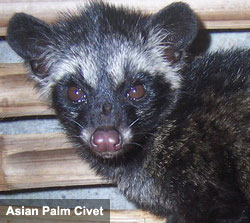
Notice that lighter nose and compare it to the animal pictured up top.
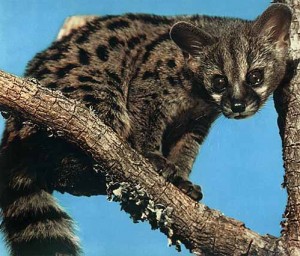
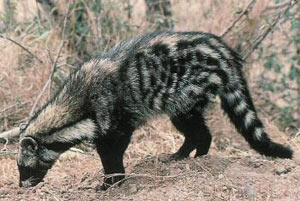
My guess is this animal is either an Asian palm or common civet (Paradoxurus hermaphroditus), or a masked or Himalayan palm civet (Paguma larvata), either one, with mange (a persistent contagious skin disease caused by parasitic mites).
Here’s one version of how the story hit the wires overnight.
‘Oriental yeti’ discovered in China
Daily Telegraph, UK
A creature dubbed the ‘oriental yeti’ is being examined by scientists after emerging from ancient woodlands in remote central China.10:34PM BST 05 Apr 2010
The hairless beast was trapped by hunters in Sichuan province after locals reported spotting what they thought was a bear.
Hunter Lu Chin explained: “It looks a bit like a bear but it doesn’t have any fur and it has a tail like a kangaroo.”
“It also does not sound like a bear – it has a voice more like a cat and it is calling all the time – perhaps it is looking for the rest of its kind or maybe it’s the last one?
“There are local legends of a bear that used to be a man and some people think that’s what we caught,” he added.
Local animal experts now plan to shipped the mystery beast to scientists in Beijing who will perform DNA tests on the beast.
Thanks to news tips from Logan Biscornet, Bob Bartholomew, Antonio Rampulla, and others for the UK story.
 About Loren Coleman
Loren Coleman is one of the world’s leading cryptozoologists, some say “the” leading living cryptozoologist. Certainly, he is acknowledged as the current living American researcher and writer who has most popularized cryptozoology in the late 20th and early 21st centuries.
Starting his fieldwork and investigations in 1960, after traveling and trekking extensively in pursuit of cryptozoological mysteries, Coleman began writing to share his experiences in 1969. An honorary member of Ivan T. Sanderson’s Society for the Investigation of the Unexplained in the 1970s, Coleman has been bestowed with similar honorary memberships of the North Idaho College Cryptozoology Club in 1983, and in subsequent years, that of the British Columbia Scientific Cryptozoology Club, CryptoSafari International, and other international organizations. He was also a Life Member and Benefactor of the International Society of Cryptozoology (now-defunct).
Loren Coleman’s daily blog, as a member of the Cryptomundo Team, served as an ongoing avenue of communication for the ever-growing body of cryptozoo news from 2005 through 2013. He returned as an infrequent contributor beginning Halloween week of 2015.
Coleman is the founder in 2003, and current director of the International Cryptozoology Museum in Portland, Maine.










I love investigating cryptid cases – but this string of “hairless mammals = monster” cases is ridiculous. The people hawking this tale aren’t cryptozoologists they are cryptidiots.
cryptidiots! …LOL good one doctoratlantis. At least they are trying….well perhaps not ;P
~if you look for logic first, you won’t look like an idiot later~
I believe it’s a common civet, too. They are popular as food items in some local Chinese markets.
Soup, anyone?
Yes, in those pictures of the Asian Palm Civet the nose is lighter than the creature in the picture. But in this picture of the Asian Palm Civet, you can see that it’s nose is much darker: