Best Witnesses: Biologists or Truck Drivers?
Posted by: Loren Coleman on April 30th, 2007
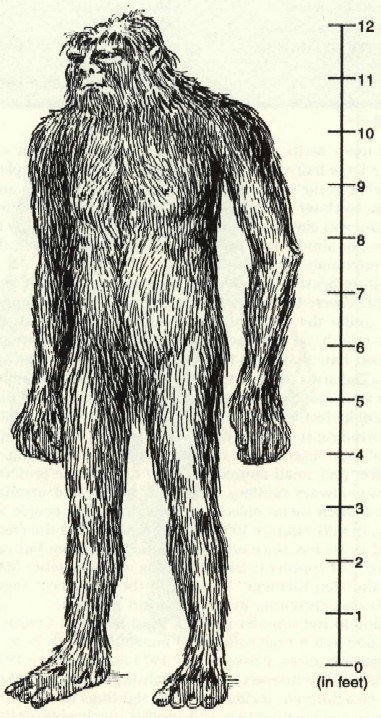
This Pitt Lake, British Columbia, Sasquatch was seen by two prospectors in June 1965. Should we discount this sighting because the eyewitnesses weren’t biologists? Credit: Harry Trumbore’s drawing from The Field Guide of Bigfoot and Other Mystery Primates.
The “Scoftic” discussion elsewhere is drifting but that’s fine, I assume, because those commenting are taking the journey as the ship steers itself in various directions.
Regarding a couple quick comments there, however, I thought I would separate them out from the terminology debate. Some people have noted that it seems certain states and provinces may not appear to be able to support a population of Bigfoot living there. But, remember, reports do not necessarily reflect that Bigfoot live where they are sighted, but only they have been seen by other primates (humans), who are perhaps merely viewing Bigfoot passing through, for a variety of reasons (i.e. migration, hunting, searching for mates).
More significantly, Cryptomundo commenters have alluded to a couple old questions I often hear on the lecture circuit: Have biologists been eyewitnesses to unknown hairy bipedal primates? Aren’t the only credible sightings those by scientists?
One of the reasons behind Patrick Huyghe’s and my writing of The Field Guide of Bigfoot and Other Mystery Primates was to show the diversity of credible witnesses. I’ve interviewed and investigated the backgrounds of many Bigfoot sighters who are more credible than some academic anthropologists, that’s for sure. Why should truck drivers be seen as less reliable than biologists?, I find myself asking, quick often.
Yes, some good eyewitnesses have been people who should know what they are observing, such as Gerald Russell, a naturalist (see FGBF, noted above, pages 126-127); Gary Samuels, a mycologist (pp. 72-73); Georg Steller, a naturalist (pp. 64-65); and physicians (e.g. George Moore & George Brooks, pp. 136-137; Ivan Ivlov, pp. 120-121; V. S. Karapetyan, pp. 92-93).
But the witnesses in Huyghe’s and my field guide also include a school superintendent, orchin collector, surveyor, engineer, geologist, timber prospector, fossil hunter, forestry committee members, reindeer hunters, construction workers, military personnel, campers, youth, Sherpas, natives, housewives, guides, and others.
Why should any of these witnesses be said to be less credible just because they are not biologists or anthropologists?

- Similar Phenomena:
I would rather look at the person, not the vocation. personal integrity and common knowledge of the area is more important to me than how many years someone spent in college being taught what is believe to be truth or fact these days.
I think that you have to judge the event or circumstance described, rather then the occupation of the describer. Many cryptozoologist make use of natives or Aborigines in their quest to track the unknown animals of the world. In the case of the Sasquatch I certainly would take the observations of Dr Jeff Meldrum in the highest regard.
Over the years I too have noticed this as a common in all sorts of crypto reports as well as sightings of any sort of unconventional phenomena. I think the most often opined reason is that the person in question is not a ‘trained observer’ and therefore their perceptions and / or motivations are automatically under suspicion.
Questions to help answer a good question, when confronted with a witness:
1) What’s the person’s reputation among people who know him? Skeptical? Cautious? Sharp and clear of senses? Not given to exaggeration? A pillar of the community; a person with high standing among all who know him? Doesn’t see things? Questions assumptions? Extremely intelligent? Down to earth? Observant? Keeps to himself; doesn’t like calling attention to himself? (Skeptics use witnesses’ reputations against them. See: Patterson. Sauce for the goose rule applies.)
1a) What’s your assessment of the people giving you this information? (GIGO, right?)
2) Is this person in the woods a lot? Does he/she know the things that live there? What they look and sound like?
3) Are there other eyewitnesses? (These questions apply.)
4) From the description, how likely does it seem that the person saw anything other than strictly what is being described?
5) Does the person seem extremely reluctant to admit to a sighting of precisely the thing that’s being described? (Most witnesses, contrary to skeptical assumptions of mistaken identity, don’t seem to have “bigfoot on the brain” and run through all the animals they know first.)
6) Does the description seem to fit general parameters established in other sighting reports? Do deviations seem to be the kind that can be explained by individual differences, or differences in terms used by witnesses to describe what they experienced?
7) Does the person’s occupation - driver; nurse/doctor; commercial pilot; surveyor; logger; engineer; construction foreman; etc. - put a premium on sobriety, steady nerves and powers of observation?
You get the gist.
If you’re getting good readings from answers to these questions - or even just most of them - you shouldn’t care whether the person is a scientist or not.
They saw something. And someone needs to explain what it is.
I also think that the reliability of the witness is of great importance, and not really what they do for a living. However, I feel that someone who is a field biologist may make more accurate observations and be able to better articulate what it is they saw in more useful detail, where some others might be at a loss for words. I also would think that someone such as Meldrum or Jane Goodall would perhaps be less likely to embellish their stories, add details that were not there, or exaggerate what they saw, which would make their testimony particularly useful. Of course no one is going to be an expert at observing Bigfoot, but someone who is trained in this sort of wildlife observation and who may have some idea of some of the physiology of what they see, as well as possessing the kind of ability to accurately describe animals on a regular basis, is going to be in some ways a more useful witness than a layperson.
I’ll try to illustrate my point a bit further. Imagine there is a sudden unusual accident or crime that takes place on the street. In many ways this is going to be a shocking and life changing event for anyone who sees it. Now imagine a regular Joe out getting coffee and an off duty police officer were to witness this event. Now I am not an expert in eyewitness psychology, but I would be more willing to value the account given by the policeman, who is trained to make observations, than the other guy. The policeman may be just as caught off guard and suprised by the sudden event as the coffee guy, but his skill at observing and recalling it will perhaps be sharper.
Of course the “crime” is the sighting of a Bigfoot, the “coffee guy” is the weekend hiker or whatever, and the “off duty policeman” is the field biologist. Just clarifying that. I know they are two different situations, but it was the first analogy that popped into my head.
mystery_man: couldn’t argue with you.
What I’m talking about is what it would take to put this sighting in the database of good reports, not what the best description would be.
Of course that picture isn’t a bad one, coming from a couple of prospectors.
Lay people don’t use technical jargon. But if one knows what to look for, one knows when a witness is describing the sagittal crest; the compliant gait; the classic body proportions; the heavy brow ridge; and a number of other characters. (When an intimidation display is involved, a lay witness’s reaction is quite sufficient.
)
And this from an interviewer’s followup to a lay person’s report from (yes, Kathy Strain), Iowa:
“…the nose which was human like but larger, wider and appeared flattened. .”
Exactly what it looks like. Many sighting reports back that one up.
And this, from the witness’s own report:
“There wasn’t any wildlife around, normally there are a lot of squirrels, and deer, but we didn’t see anything other than the Bigfoot. Even birds were absent in the area.”
Another classic characteristic of sighting areas.
Scientific description: better. Lay description: usually good enough.
DWA- I saw what you meant.
Your post is an excellent set of questions to ask when screening for witness reliability. I was just making a general comment on the usefulness and quality of eyewitness testimony coming from biologists and it wasn’t really related to what you said.
I consider myself to be an honest person but I would not be able to decide what I saw if it was under the circumstances of a short sighting in heavy vegitation or something blurry like that. I would probably not be able to tell the difference between a bear and a ape like creature in such conditions (I have never seen a bear apart from in the zoo and then I was sure cause there was a sign that said Swedish brown bear). Considering this makes me realise that a sighting from a person who is familiar with the area and knows the local fauna well is more reliable than a sighting from some city guy like me. But no sane person should be taken for a liar, especially if the person has no reason/s to lie or make a prank.
Pentastar: having spent a lot of time in the woods and seen quite a few bears there, I can tell you that when you see a seven-foot bipedal ape, it not only won’t look like a bear, but that you’ll think bear first, before you conclusively rule it out.
I think it’s very conceivable that many sasquatch have been seen by people who got the kind of very bad glance you’re talking about, and just presumed it had to be a bear…but I consder it highly unlikely that a misidentification could run the other way.
Loren, re: “Some people have noted…certain states and provinces may not appear to be able to support a population of Bigfoot living there…reports…only reflect they have been seen by…(humans), who are perhaps merely viewing Bigfoot passing through…”.
It may also be areas from where there’re few or no reports are areas where they’re taken for granted or even deliberately unreported to protect them, (in the way Prince William was said to’ve been treated normally and even protectively isolated from outsiders by locals while attending University in Scotland).
In fact, in some cases it mightn’t be the Bigfoot who’re passing through but the witnesses.
As for credibility of witnesses, I’m with you 100%!
In fact, if personal experience of numerous doctors and professors belonging to a variety of disciplines is anything to go by, I might even favour the testimony of an ordinary witness operating in their native environment to that of an ‘expert’, many of who’ve shown themselves up in my eyes while in the field.
Having had the opportunity to observe a few REAL scientists positively thriving on being confronted by the general chaotica of novel situations found in the field, it’s very easy to recognise how the majority of scientists quickly find themselves completely out of their depth on leaving the carefully controlled and highly predictable confines of the lab, or the safety provided by giving lectures on the kind of ‘classic examples’ mainly only found in text books.
I agree with most of you here- we need to judge the individual not their occupation, for all the reasons that have been raised.
It is just dumb blind faith to trust someone because they are a scientist (i’m saying this as a scientist- of sorts- and as someone who values science extremely highly). You only need to look at, for instance, that korean cloning scientist and his faked results.
Of course, some scientists are going to have greater relevant knowledge about animal behaviour and anatomy and such like (but notice that is only some scientists- and indeed only some biologists- if their specialism is bacteria or earthworms or fish then well I reckon i might know just as much. And many scientists- including many biologists- spend a hell of a lot of time in labs looking down microscopes, rather than actually being in the field).
Experienced hunters or hikers are likely to have greater knowledge of local conditions and wildlife. And policemen might have been trained to carefully note details when under stressful conditions (although i don’t put too much store in that…).
One thing though, we should accept that this cuts both ways- we can’t just use this to defend sighting reports by non-scientists- it also means we shouldn’t be too hasty to suggest that when a scientist claims to have seen a BF that this is necessarily better evidence (which i think some have a tendency to do).
prince william… sasquatch… hmm
now you mention it there is something about the eyebrows.
I don’t think that it’s a person’s job that make him or her a better witness. I have interviewed hundreds of witnesses, all the way from professional biologists, archaeologists, pastors, to housewives and high schoolers. What makes a report “believable” is the content itself (accuracy of details and consistency of the witness with the written report and a verbal interview).
And DWA, you are more than welcome to believe whatever you want to, but just because a database lists a report for a certain state or location doesn’t mean it’s accurate or truthful. I could easily point out reports on a certain popular website that I know, for a fact, are misidentifications or downright hoaxes. Thirty-five reports for an entire state, especially when they are widely spread and isolated single reports, is not believable or scientific.
Kathy Strain:
One can do with sas reports what one can do with reports of any other animal. But only so much.
CA doesn’t have many more reports, per capita, than IA. No state has many, when you consider the size of the critter, and the curiosity it seems to exhibit in numerous reports. But then, the vast majority who see them, count on it, say nothing. Many just can’t; many don’t know where they can and be believed. You can only go so far with data being “believable and scientific” with a phenomenon that isn’t even agreed upon to exist yet.
What is scientific is, and can only be, this: let the chips falll where they may, let the reports be where they happen, and see where concentrations are. Those are where you want to hunt for more evidence. As I said on the other thread where this came up: why are we keeping CA sightings and dumping IA? And look how many are in OH. Dumping those too? Now ALL the sightings start to look suspicious. Because they start to reflect personal biases rather than natural phenomena external to the cataloguer. There’s nothng more unscientific than that.
You can only “purge” the database for reasons that make sense. That the animal isn’t where you want to see it is irrelevant. The animal didn’t ask you; its needs and movement patterns aren’t known to you. You have no good reason to do anything but collect evidence, until you have proof. Then the good data begins to sort itself out.
Loren, interesting blog. Thanks.
I’ll honestly admit that the “dream report” would be a report submitted to the TBRC by a Texas Parks and Wildlife field biologist, who had a lengthy, close encounter with multiple sasquatches within the last 24 hours. Likely to happen?
Dream on.
If the trucker can be evaluated as a highly credible individual and his report can be corroborated by substantiating physical evidence, his report would be considered a Class 1 sighting by the TBRC, or at the very least, a Class 3 sighting (without corroborating evidence), under our new classification system.
If a field biologist had the sighting with corroborating evidence, his report, like the trucker, would be considered a Class 1. However, with no accompanying evidence, the field biologist’s report would be a Class 2.
Those whose report would be a Class 2 (without accompanying physical evidence) would be (for example) “biologist, ranger, trapper/seasoned hunter, bird watcher, game warden, naturalist, law enforcement” or someone who “is experienced in the outdoors and/or accustomed to looking for details.”
So, from my perspective, there is some advantage to having a field biologist as a witness (especially one of positive repute), but there is also equal or similar value to a report from someone who is experienced in identifying wildlife or is trained to recognize and report on events of great detail.
We can all swap theories and opinions, but if you’re looking for the facts, there’s plenty available. Decades of psychological studies have repeatedly and consistently shown that eyewitness testimony is often unreliable.
Loren himself admits this when he (quite correctly) states that the vast majority of Bigfoot sightings are misidentifications. So that’s pretty well a proven fact.
It doesn’t matter if you’re a police officer, a field biologist, a boxer, or a game warden, we are all equipped with the same demonstrably fallible perceptual and psychological processes. Yes, you would expect an outdoorsman to better identify a bear than an office worker. So what?
Most Bigfoot reports come down to “I saw something big and hairy, and it wasn’t a bear.” Even assuming that’s true, that is a NON-description; it just says what the person thinks it wasn’t, not a positive identification of a Bigfoot.
The person who thinks he cannot be fooled has already fooled himself.
Kathy is right on the money with this note:
I could easily point out reports on a certain popular website that I know, for a fact, are misidentifications or downright hoaxes.
Without a valid way to tell a real sighting from a false one, it’s all mixed together…
First, as a lay person with some education in biology and forestry long ago, and having spent many thousands of hours in the woods for work and recreation, when you see a sasquatch up close, the impression is burned into your brain. It’s just too bad I couldn’t press the Print button from my first encounter nearly 30 yrs ago, because the detail I absorbed back then was incredible. I can still recall my making detailed mental notes of his palms, bare feet bottom, facial hair, nails, eyes, thighs, biceps, hair length, chest size, height, etc. Problem now is, the specific details of those observations back then do fade over time. Without going into every element, my two more-recent visual encounters were not as descriptive in detail because of lighting and angle, but there was definitely sufficient information to make a conclusion of what I was viewing due to overall size and profile of subject with limited detail. I also had other supporting information such as sounds, breathing, smell, etc.
I think one big component in witness testimony is the interviewer himself, because they can have their own set of rules which can interfere or reinforce with the actual testimony. Is it a police officer or Federal forester who doesn’t want to file a formal sasquatch report in the first place because of his fear of ridicule? Is it a non-believer who is actually trying to disprove sasquatch in the long run, so finds non legitimate reasons to discount a claim? We’ve all read the ridiculed sighting reports floating around after the media gets ahold of them. Or is it a researcher who already has their preconceived notion of what is and isn’t sasquatch behavior or physical attributes, and therefore cuts portions of testimony he/she may dislike? Or finally, is the interviewer someone who is open minded as a result of previously recognizing that sasquatch may not fit within the comfortable box some may want to fit him in? Of course then sadly the interviewer himself can come into question if his/her peers or readers fall into one of the above categories. So the troubled credibility question continues.
I suspect some very valid witness testimony has been completely thrown out simply because there was one or two elements that a dogmatic interviewer had no room for in their comfort zone. In essence, they threw the baby out with the bathwater. A good witness and valid report are often sadly discarded when a single questionable element in a claim is present.
Here’s an example in my own experience. Last year Autumn Williams asked if I would mind doing an interview for the SciFi Investigates program. After much consideration on my part, I decided to go ahead. Keep in mind, I have had 3 visual and 3 vocal/interaction type encounters in my life by then. At one point in the interview, I had to look at my records to recall the order of one of the visual encounters to one of the non-visual encounters. Remember, we’re talking about a span of almost 30 years and I couldn’t recall if the second sighting came before or after a specific vocal encounter which were both almost 20 yrs ago.
Apparently, my having to look at my notes became a major factor of my interview not even being included in the show. I’d like to see them treat Jane Goodall the same had she wanted to be certain of some details. They wouldn’t. In fact, if any credentialed witness needed to look at their notes, they would be recognized for their thoroughness. So I have to wonder if there may be a double standard we have in the field that needs to be exposed? In the end it was just as well I wasn’t included, because the show wasn’t a documentary anyhow, it was about ratings.
As far as scientists as eyewitnesses, there may be some issues here. For instance, would a scientist dare report some of the things sasquatch are reported to do if they see it? Will they report the glowing red eyes when there was no external illumination? Will they report tracks beginning or ending in a snow field without explanation? (Neither of which I have ever seen) Would they dare report some of the stranger things being reported by what are likely credible witnesses?
I’ve jumped around a bit because the issue of witness credibility is a little more complex then just the witness themself. In short, the credibility, quality, and content of the witness may actually have more to do with the interviewer then the witnesses.
Overall I agree with much of what Senor Multiple wrote. I do want to address one theme I keep hearing: ridicule of eyewitnesses. I know this is one of Loren’s themes, that a big problem in crytpid research is eyewitness ridicule.
He wrote: “who doesn’t want to file a formal sasquatch report in the first place because of his fear of ridicule? We’ve all read the ridiculed sighting reports floating around after the media gets ahold of them.
I keep hearing about all this alleged ridicule, all these credible eyewitnesses who are shouted down with laughter…
Where? When? Names, dates, examples, please?
Since it apparently happens all the time, I’m sure there are plenty of examples. Can someone point me to all these news reports in which the eyewitness is called crazy, or told they are stupid or foolish?
I’m starting to wonder just how real the “ridicule factor” is. Everyone seems to be sure it exists, but I’m looking for actual examples. Anyone?
MultipleEncounters: Great post. right on the money. When it comes to the sasquatch, there’s a big double standard, that is often passed off as “extraordinary claims require extraordinary evidence.”
Think about it. All that means is: claims require evidence.
Speaking of which: back to Kathy Strain’s claim that there are “reports on a certain popular website that I know, for a fact, are misidentifications or downright hoaxes.” Such a claim (as we see here) plays right into skeptics’ hands; with no specificity, they’ll apply it to every claim on every database.
As an equal-opportunity skeptic, I clearly recognize that this claim requires:
1. Naming the database.
2. Specifying the sightings.
3. Noting, for each, whether it is a misidentification or a hoax.
4. Presenting, for each, the corroborating data.
That is an extraordinary claim. It requires extraordinary evidence.
(That is a claim. It requires evidence.)
One of the problems I see proponents have with skeptics is that they don’t hold skeptics’ claims to the same standards of evidence that skeptics reserve for proponents.
I hold the claims of both sides to the same standards.
Ben: here’s all the data you want for your request.
Get up tomorrow morning. Decide you’re going to tell everybody you meet that you saw a sasquatch recently.
EVERYBODY YOU MEET.
Document the responses. That should tell you all you need to know.
If you’re afraid people you don’t know will think you’re crazy just because you’re talking to them, limit the sample to people you know well. I predict similar results.
Do this. I need to know if I’m right.
In typical fashion, I ask for evidence and facts, and DWA offers only jokes…
Can anyone with any credibility offer a list of cases where eyewitnesses were shouted down or ridiculed? I have interviewed dozens of Bigfoot eyewitnesses, and have treated every last one with courtesy and respect.
I don’t doubt that every now and then there is some background snickering by those hearing about a Bigfoot encounter, but I don’t see any evidnece for the widespread, systematic eyewitness ridiculing…
How in the world can purging a database of clearly inaccurate or misidentified witness reports be personal bias when how those reports got into the database was a personal bias in the first place? DWA, you seem to be under the impression that databases represent imperial data when in fact, they only represent what a human decided to put in (and by default leave out as well). You are also making an assumption that all those reports were thoroughly investigated and therefore represent accurate reports, when I have already stated (having been a former curator of said organization) that isn’t so. Many reports are in that database with NO investigation what-so-ever and are only there because they “sounded good.” I don’t know what you know about the scientific method, but I assure you, that an’t it.
Yes indeed there are reports identified for California that should be purged because they are highly suspect based on the location…just like I would purged reports from parts of Nevada, Utah, New Mexico and Arizona. It isn’t subjective to state that there has to be water and food, at a minimum, for a bigfoot population to be present in a given location. To continue to argue that we should just accept all reports that are in a man-made database because they are simply in a database is far more dangerous than stating we should throw them all out.
Ben: most of us know red herrings when they’re brought to us on a plate.
Kathy writes “How in the world can purging a database of clearly inaccurate or misidentified witness reports be personal bias when how those reports got into the database was a personal bias in the first place?”
Kathy, you are making too much sense, being too logical…
DWA - My statement that there are false reports in a certain database falls right into the hands of skeptics? Good. First of all, it’s true. Check out Clark County, Nevada and get back with me. Second, maybe if there were less stuff like the footprint report above there would be no need for terms like scoftic because there’d be nothing to scoff at….
Kathy: not sure you could misunderstand more what I said.
On what basis are you purging? All I asked for is the evidence. What’s “clearly inaccurate”? A sas in IA? Who’s making the judgment?
As I’ve said, I’ve read reports from IA - and other “unlikely” states - that seem as good as any from CA. Water, food and all present. A witness who gives a very good description, of an animal who seems to be in habitat much like that in which it’s found elsewhere. Don’t believe me? Bindernagel (and I) once felt the way you do about this. We changed our minds when we kept looking at data. Because it started to make sense.
If you drop anything, you need to say why.
If there’s one kind of data I would mistrust, it’s “imperial” data. Likewise, “imperial” dropping of data.
WHERE PEOPLE SEE THEM IS WHERE THEY DO. Unless there is incontrovertible evidence that they misidentified something or lied.
Knowing some scofftics (really well
), I can tell you how they’ll interpret your first paragraph: who knows how anything gets into those databases? Even the proponents think whole states should get thrown out. What does that say about the ones that get left in…?
And I should point out another major problem that proponents have, that by itself has caused a whole lot of internecine warfare on the sasquatch:
Too many proponents think they know exactly what this critter is, what kind of places it frequents, and where we should see them.
NO ONE KNOWS, FOR SURE, WHAT THIS IS. Or how, or where, it lives. The best we have are educated guesses. Nomadism is an educated guess that comports with the behavior of known animals; explains sightings all over; and provides insight into why it’s been so hard to nail the sas down.
If a sighting has passed the general criteria - sober, apparently credible witness; clear description fitting to what’s been reported in other sightings; lots of corroborating detail including multiple witnesses if available (as in several IA sightings, just had to toss that in) - it’s a good sighting. Insofar as any sighting can be considered “good” before proof is obtained.
We don’t know the animal’s habits. Making turning around and dumping reports because we don’t like where they happened, to say the least, premature.
Ben,
The ridicule factor is present everywhere, you just need to look closer.
Look at how Prof Meldrum was ridiculed by some of his peers at Idaho State University. He is a witness in that he has found and cast tracks. Maybe ask Meldrum if he thinks there is such a thing as ridicule.
Look at how Krantz was equally ridiculed by his peers at Washington State University.
Look at how the news media ignores reports in communities then chuckles after they refer to how bigfoot was already proven a hoax by Wallace on his deathbed.
Look at how few higher-ups in the USFS, BLM or USFWS with knowledge of bf, will dare speak publicly about sasquatch. (Of course there have been none willing to speak publicly), yet I know of several who have convided privately and in email.
That’s just a few examples of the ridicule factor I could think of off the cuff.
BREAKING NEWS:
HELL HAS JUST FROZEN OVER
I never thought I’d agree with something DWA wrote, but then again even a broken watch is right twice a day.
He writes: “NO ONE KNOWS, FOR SURE, WHAT THIS IS. Or how, or where, it lives. The best we have are educated guesses.”
That is so true, but notice that DWA later contradicts himself by calling Bigfoot an animal. If no one knows for sure what Bigfoot is, how does he know it’s an animal?
My own definition of Bigfoot is much more accurate: it is a label for the experience of seeing something large and hairy that the eyewitness cannot identify. So I’d include that in “what Bigfoot is.”
Actually, DWA, I think you aren’t getting at all what it is that I’m saying and have no intent on doing so. I’ve never quite seen a self confessed skeptic argue so hard for including crap reports with the good ones. Do you have any knowledge of the database we are arguing about, other than what you have read on the website?
I also find it hard to believe that Bingernagel would agree that bigfoot could occupy any location regardless of habitat or resources. Nor would Krantz…or Meldrum…or Higgins…or Noll.
We are all animals.
And I should add: as to the vetting reports receive before they’re put in, that’s obviously not my problem.
I was wondering about many reports that don’t show the follow-up evidence that the website insists must be done before any make the database.
But here you have a baby/bathwater situation. Should a report that would pass all the tests if the witness got interveiwed get tossed, solely because the witness wasn’t? it’s a legitimate question. Saying “toss” could get rid of a lot of usable data. Why not simply put in a retro caveat and take it from there?
And I’d dispute another point. I think tossing everything would be FAR more dangerous than leaving everything as it is, with an appropriate caveat. At least if you’re interested in finding out anything about the animal.
Kathy, are you saying that if the vetting wasn’t done, it can’t be now? Cold followup is better than none, I’d think.
>>Look at how Prof Meldrum was ridiculed by some of his peers at Idaho State University.
I will grant you that Meldrum has endured some ridicule, specifically when someone asked him if he will be searching for Santa Claus next.
However, that was not the claim; Jeff is not, and has never claimed to be, a Bigfoot eyewitness. Nor, to my knowledge, was Krantz.
If you will read the original post, and Loren’s writings, the comment is that eyewitnesses are often ridiculed, and I’m asking for examples.
Actually, Ben, if you read sighting reports you’d know:
1. Bigfoot is an animal. Maybe not a fact (yet), but a more than fair educated guess. (I refulse to caveat-weasel-word everything I say about the sasquatch.)
2. Bigfoot is clearly identified. A biologist could plot every aspect of sightings on a bell curve (been done) and go, wow, that’s a species.
And here I didn’t think you were right even once a day!
Hey Ben, how’s it going?
You asked for examples of ridicule? Okay. This one involved my lovely wife:
She was in the breakroom where she works, and the marketing guy approached her about the subject of bigfoot, and my involvment in it, apparently feigning serious interest. My wife fell for the gag, and began to tell him about a recent event. The guy interrupted her with a dismissive, ridiculing groan and made a sound like “Pfffft!” She stopped and said, “What?” He then asked her, chuckling, incredulously, “You mean you REALLY believe that CRAP?!?” My wife took offense, stood up and said, “Of course!”
The guy smirked, chuckled and mumbled something to himself, and walked off.
Another that comes to mind involved my very good friend, Craig Woolheater, when he was being interviewed by a radio station. While I don’t remember specifics, the ridicule got so bad that Craig cut the interview off.
It’s real, Ben, and is quite pervasive.
After church on Sunday, my wife and I were greeted by two nice couples and their children. One of the men, who seemed really interested, asked about my involvement in the subject. He is involved with an outdoors mens’ Christian group that has had me as a speaker a few times on the subject. When one of the wives heard what the subject was, she broke into laughter, and said loudly, “You’re kidding right? When my daughter mentions it, I tell her she’s nuts!” When I told her that I wasn’t kidding, she then apologized and said, “I’m sorry, I didn’t mean to laugh.”
I told her it was okay, and that I understood the difficulty in considering the existence of bigfoot. She turned and walked away, and then her husband began to ask quite a few serious questions about it.
Anyway, there are many many examples that are similar to these, but I think I’ve said enough.
Yes Ben, that is correct, neither have ever claimed to have ’seen’ a sasquatch. I used the term eyewitness too loosely to include finding tracks.
However, I do now recall Prof Krantz stating that his wife has seen one. That may not make him a full eyewitness, but he was married to one.
For a second, I misread and thought you said Krantz was married to a Bigfoot, not an eyewitness!
I’m pleased that DWA knows for a fact that Bigfoot is an animal and has been identified.
…Right after he wrote that no one knows for sure what Bigfoot is.
Anyway, my request remains, to anyone who believes or claims that Bigfoot eyewitnesses are often ridiculed, and that this is a common or significant phenomena.
Examples, please, of specific news reports or instances where officials have publicly ridiculed eyewitnesses into silence. According to Loren Coleman and many others, it happens all the time… surely there should be dozens or hundreds of cases.
Note that “not believed” is not the same as ridiculed; people make claims all the time that are not believed (from car salesmen to politicians), but that doesn’t mean they are ridiculed.
Ahhh. Here we begin to get to another bit of need of definition of terms. It is now clear that Ben defines ‘ridicule’ differently than some others might. Perhaps if we managed to arrive at an agreement on what terminology to use to apply in what instances then we might get closer to a consensus. Since Ben is asking for examples, perhaps he would grace us with his definition of ridicule. Then there might be some chance of satisfying his request.
Here’s what I find at the Yahoo reference site:
rid·i·cule (rd-kyl)
NOUN:
Words or actions intended to evoke contemptuous laughter at or feelings toward a person or thing: “I know that ridicule may be a shield, but it is not a weapon” (Dorothy Parker).
TRANSITIVE VERB:
rid·i·culed , rid·i·cul·ing , rid·i·cules
To expose to ridicule; make fun of.
ETYMOLOGY:
French, from Latin rdiculum, joke, from neuter of rdiculus, laughable ; see ridiculous
OTHER FORMS:
ridi·culer (Noun)
SYNONYMS:
ridicule , mock , taunt 1 , twit , deride
These verbs refer to making another the butt of amusement or mirth. Ridicule implies purposeful disparagement: “My father discouraged me by ridiculing my performances” (Benjamin Franklin). To mock is to poke fun at someone, often by mimicking and caricaturing speech or actions: “Seldom he smiles, and smiles in such a sort/As if he mock’d himself, and scorn’d his spirit” (Shakespeare). Taunt suggests mocking, insulting, or scornful reproach: “taunting him with want of courage to leap into the great pit” (Daniel Defoe). To twit is to taunt by calling attention to something embarrassing: “The schoolmaster was twitted about the lady who threw him over” (J.M. Barrie). Deride implies scorn and contempt: “Was all the world in a conspiracy to deride his failure?” (Edith Wharton).
I agree that definitions are important, and I’m happy to use the definintion provided. We were not using ridicule as a noun, but as a verb: “eyewitnesses are ridiculed.”
Thus “To expose to ridicule; make fun of” is a perfectly acceptable definition for me. Let’s see this slew of cases where Bigfoot eyewitnesses were “exposed to ridicule” or “made fun of.”
Not “disbelieved,” not “ignored,” but mocked, exposed to ridicule, or made fun of…
I’d add that ridicule implies public mocking; if a person just thinks to himself or herself that an eyewitness is stupid or crazy, that’s not ridicule. If that person says that to others, or prints it, that is ridicule.
O.K. Ben, here’s your challenge; Send a request to every State Commissioner of the respective Department of Natural Resources or Wildlife Agency Director and ask about the Bigfoot population in their state.
Next, send the same request to the Wildlife and Fisheries Department of every major university that has a program.
By the way, ridicule, like racism has many forms.
I’m finding this very instructive, really fascinating.
I ask for specific examples of Bigfoot eyewitnessees being ridiculed (which supposedly happens all the time), and so far I’ve gotten two responses:
In the first, MultEncounters was honest enough to admit that Meldrum wasn’t really an eyewitness and (after I was honest enough to admit he had been subjected to some ridicule).
In the second, I’m told I need to send a letter to every Wildlife department or something…
It’s amazing the contortions people will go to when they (apparently) don’t have facts to back up their assertions.
That’s okay, I don’t expect an answer immediately. I’m happy to wait for someone to cite me list of examples.
hey loren & everyone great new article about sasquatch. yes i agree with all the above replys as well. thanks bill
very informative.
Hello Kathy,
Since we’re onto the subject of validity of witness testimony and of purging reports, I’d like to pose a question for you of a report that you wrote off at another forum. It involved the capture of an injured sasquatch during the Battle Mountain Fire in Nevada in August 1999 by fire personnel. (FYI, I too was a wildland firefighter.)
In this other forum you stated that you were “the original investigator of that report”. I have chatted with Thom Powell in the past about the incident, which he has written about in his book ‘The Locals’, and he doesn’t seem to recall you being the ‘lead investigator’ or with the organization when the report actually came in. I just wanted to clear this up because I remain interested in that incident, and such contradicting information simply must be clarified.
Clearly it can be important since we’re talking about a very high profile event. I am under the impression that someone else was the lead investigator.
You also didn’t feel the habitat was there to support sasquatch, but this reasoning would completely ignore the possibility of a sas simply passing through and getting trapped. Not to mention, as raised before, nobody knows exactly what a sas needs and his access to caves, deer, and ground squireels could have been sufficient to sustain him.
At what time did you actually investigate the report and in what capacity?
This alleged capture and testimony by a seasonal firefighter, could have been such a pinnacle event proving sasses’ existence. Not to mention demonstrating knowledge by our own government, and a subsequent coverup as well.
I think this thread tends to raise a very important issue about what criteria (and whose) is used in order to purge or pursue reports in what organizations?
Anyway, I just find this capture report significant because it would be a terrible thing to see such a high profile case discounted and possibly purged for the wrong reasons. It might also prove existence of a government coverup the likes of which I suspect do in fact occasionally occur.
Dave
Hmm, the firefighter may have been seasonal or may have been full time. It again depends on whose statements one believes.
Wow, a lot of good discussion.
OK, a few points from an admitted armchair researcher without field experience.
A report may be valid regardless of the source, but it’s not going to be given the same credibility by a “mainstream” of scientists and officials - REQUIRED to establish a new species officially - from a truck driver as from a field biologist. Conversely, a related degree is not a guarantee of a witness being correct: no disrespect to Dr. Samuels, but it would be easy to note that a mycologist is not a primatologist.
I’ve mentioned my dad saw a large black “panther” cross the road in front of him in Maine about five decades back. Now I know Dad could make a mistake, but I don’t think he did. That, however, is my opinion based on personally knowing the individual. I can’t expect anyone else to accept this as authoritative on my “second-hard say-so.” It’s another bit of evidence in the file, but it’s not going to convince the FWS to do any serious investigating.
As to sasquatches seen outside the PNW: We don’t know an unconfirmed animal’s range (pretty much by definition). We can, and should, look at where the more impressive reports come from (a subjective judgment itself, of course) and how suitable an environment is for a large animal’s need to find food and stay concealed. I’m more skeptical of reports near large population centers, in desert environments, etc. because the animal is less likely to be there. Not impossible, but less likely. If you need a population in the hundreds for survival, then you need a habitat where hundreds could live, breed, hunt, and die without, in many decades, having even one specimen killed by an elk hunter, or hit by a truck, etc. (Stories where specimens were lost, where a hunter did take a shot but failed to kill, etc. are no different as evidence than any other “I saw it” stories.)
I’m not much on conspiracy theories. Yes, academics who investigate sasquatch get a hard time, and agencies like the FWS or state wildlife departments, inevitably saddled with huge responsibilities and inadequate fuding, are likely to brush off a sasquatch unless it’s seen by either a scientist or one of their own people. (And maybe even then…)
To use another one of my tales, my friend Tom saw a grizzly very close up (as in inches away) in Colorado (where they are extinct). Tom is a lifelong outdoors guy and a former intelligence officer so solid that, if he told me he’d seen a sasquatch at similarly close range, I would personally accept that as proof of sasquatch. A Colorado wildlife officer to whom he reported this suggested that, even if Tom was sure it was a grizzly, he accept it was a black bear to prevent a major disruption in hunting, etc. in that area of the state. Now that officer in some sense shirked his duty, no doubt justifying it by thinking that a lone grizz could have been a wanderer, and its importance was not great enough to deal with the consequences. However, a more recent account, again by a lone witness, drew a pretty extensive official search. So a lot depends on luck - who happens to listen to the witness.
Matt Bille
Hey Dave - yes I was the original investigator. As I recall it was prior to FLATS. I was asked to investigate the report because I had just come to California from Nevada (working for the U.S. Forest Service) and had the right “connections”. After checking the facts of the report, I concluded it was a hoax (and hence why the report is not on the BFRO website). I never gave the report another thought until I read it in Thom’s book. It seems very implausible that after all this time not a single other person has come forward with telling the same story (not to mention that the witness was not telling the truth about being a federal employee).
As I recall there is another report in his book that I was the original investigator on. Thom called the witness after I had already done the report. I have never had an issue about Thom following up on other people’s reports…our only disagreement was if the witness was believable and if the event really occurred.
“It’s amazing the contortions people will go to when they (apparently) don’t have facts to back up their assertions.”
I know. It’s amazing to watch what scofftics (in case of emergency, break glass) have done rather than back up their assertion that all sasquatch data is hoax, lie or hallucination. They ask a list of citations for a phenomenon pretty much as pervasive as bacteria. (Ben: read sighting reports - you can start any day now - and you’ll get copious renditions of what-happened-when-I-told-people. No need for us to recount it here.) This request list - when they are pretty much Exhibit A of ridicule, this red-herring routine being only one example - is a standard scofftic tactic. When you see a scofftic come up with real data to back his assertions, tell me. They have a position too, and unlike the proponents (for all their problems), they’ve done little or nothing to back it up. Other than call people liars - in nicey-nice words - and condescend to them.
Sorry folks. When someone does go scofftic on me, I’m calling it. It’s like heroin. I can’t help it!
But I do have to say this: those who made the point that scofftic is a convenient term when you find scoffticism rampant, well, they HAVE a point.
And Ben: My little project for you, up there? It would bring the phenomenon home to you, up close and personal, sort of the “Black Like Me” of squatchery. Ground-breaking field research. I mean it. Try it.
BTW: it’s cool to see Matt Bille (a true skeptic) and Ben Radford (a scofftic) on the same thread. Sorta highlights the distinction we’ve been going over on that other thread. Thanks for visiting, Matt. Definitely a breath of fresh air.
Ben is quite right that eyewitness testimony is exceedingly, shockingly unreliable—that’s what the psychological literature has established beyond any doubt through decades of relevant experiment. It’s a fact of life we just have to work around.
But I thought I might make a note, not about eyewitness testimony itself, but about how skeptics approach it. On a previous thread, Sergio mentioned that skeptics can become “scoftics” when they set aside eyewitness testimony. He also writes,
Here’s my take. Bigfoot witnesses have had an experience that has given them a privileged viewpoint on the question of Bigfoot. The assertion that “any argument that you can throw at me holds absolutely no water, because I know firsthand that you are wrong” seems to me like a bit of a conversation-ender; but, on the other hand, how can a witness pretend that they didn’t see what they experienced first-hand?
Skeptics are stuck: no one can take away a Bigfoot witness’ first-hand experience—but without further evidence I can’t claim with any honesty to know what it was.
That’s not a coded way to insinuate that eyewitnesses are liars (though I can’t avoid the fact that some important eyewitness sasquatch testimony has proven to be fraudulent). It’s just that I can’t do much with anybody’s given story by itself. I wasn’t there. I don’t know anything about the witness. I don’t share the privileged vantage point.
All I can do is proceed with what I do know—which isn’t much, in most individual sighting cases. I know the witness said they saw a sasquatch. After that, I’m just guessing. Every person’s individual Bigfoot sighting claim is a new mystery, and there are a terrific number of possible solutions I have to consider. One of those is Bigfoot, but unless I have clear corroborating evidence to help narrow the field of possible explanations, all I can do is set that story aside until more evidence emerges. Unfortunately, in many sighting cases, there is no possibility of any further evidence ever emerging specific to that particular sighting claim.
My point here is just that merely setting a story aside does not in itself constitute “scoffing.” It’s just the only intellectually honest approach I know. I generally don’t have any opinions about any random witness’ trustworthiness, one way or the other, because I generally have no information about that.
It’s just that I can’t accept an uncorroborated account as accurate without outright guessing.
Oh, and Ben, joppa has given you another assignment. One that many who have seen or heard a sasquatch have tried with their local DNR, with predictable results.
I’d give you two reports i know of right off the top of my head, but I know how this red-herring thing works. (It already has. “Only two.” That’ll morph to “Only two hundred.” “Only two thousand.” No thanks. Some movies I only have to see once.)
You never do anything here but crap on proponents’ opinions. Get off your lazy scofftic butt and do some fieldwork! joppa gave you a VERY specific tasking.
As did I.
Get crackin’.
Radford’s question about ridicule is a good one. Are there cases where a bigfoot eyewitness has been exposed to ridicule? I would guess it might be common, but I’m curious whether this can be pinned down to specific cases…
OK, for Daniel I’ll do two. (He tends to ask nice.)
1. http://texasbigfoot.com/Montgomery12.html
2. http://bfro.net/GDB/show_report.asp?id=1372
I don’t have time to mine databases. But those are typical. (And yes, I think being warned about using alcohol while hunting counts as ridicule. I’d have shot the guy.)
Cool, thanks.
(Those cases are unfortunate. No one deserves to be treated poorly as a reward for trying to do the right thing.)
Ben,
I think the most important perspective of the ridicule question is not regarding ‘documented’ ridicule found in any news reports, but it is the ‘fear’ of ridicule, and the ‘whispers’ that take place in the back rooms where you work.
I guess tell everyone at work that you saw a sasquatch over the weekend and see how it goes. Then after a few days, tell them you were merely conducting an experiment to see if you can get them to tell you what they said about you.
Not everyone is this way but if anyone thinks this doesn’t happen, then they haven’t been around. It’s the same old story no matter what the unbelievably sounding claim may be.
Why do you think sasquatch is where it is in our societal acceptance, and not having been listed as a member on any evolutionary tree?
Dave
I think that being ridiculed can’t be the only reason people fail to report cryptid sightings. If that were true, the YouTubers and Dominic Perezes of the world would think twice before parading their pathetic hoaxes across the internet.
But seriously, who do you contact to report a cryptid sighting? The police? The zoo? Tom Biscardi? If I were lucky enough to glimpse a cryptid I don’t know who I’d go to with my information.
Gee, Ben I thought you wanted to experience ridicule first hand, but let me give you an interesting example of institutional ridicule:
I spent several years in various positions with a State Natural Resources Agency. I even got to make some policy. We would get wild and wooly critter reports all the time and occasionally Bigfoot sightings. Guess who, got to follow up, investigate and write reports.( these weren’t for public consumption or to be posted on the internet and they probably don’t exist anymore ).
One fine day, the question got bandied about, “What if these boogers exist ?”
Answer: “They don’t, until somebody higher up than us or better, some recognized scientific body says they do. ”
“What do we do with the reports, if credible ? ”
“Ignore them.”
“Why?”
“It’s not what we do !!! We are paid to manage game species, protect endangered ones ( only those with money and grants attached). When we get a Bigfoot department funded, we will worry about Bigfoot.”
Now, this thread was about credible witnesses, and I talked to some pretty damned credible folks. But I got to write nice letters to these folks: ” Dear Mr. Witness, Thanks for your letter. You probably saw a bear. Don’t shoot at it, ’cause you can’t hunt bears in this State. Have a nice day. “
Nope, Kathy, we just seem at loggerheads, but I keep trying.
“I’ve never quite seen a self confessed skeptic argue so hard for including crap reports with the good ones.”
Don’t even understand what that means. What’s a “crap report?” What’s a “good” one? How do you make that determination? Your problem, not mine. (Although I could give you some guidelines; and “nothing from Iowa” is a BAD one.)
“I also find it hard to believe that Bingernagel would agree that bigfoot could occupy any location regardless of habitat or resources. Nor would Krantz…or Meldrum…or Higgins…or Noll.”
Nor DWA. It’s just that some of us think IA is great habitat for the sasquatch. (Hint. IT IS.)
And no I’m not from there. It’s just that I think sas researchers shouldn’t be ruling stuff out when so little is known for sure. 35 reports from that state is A LOT. It’s IOWA, ferpetesake. Where if you see something like that you’re a NUT.
(Yeah, you are in CA too. But still.)
you know, I miss all the fun when I get too busy for a couple of days…sheesh…
Scoftic is a great word and I intend to use it on a daily, weekly and moment to moment basis.
You Scoftics are arguing over orange rinds and orange peels.
Getting back to truck drivers…eye witnesses are on an even field–what can be observed in a laboratory has nothing to do with what is observed in the world outside the big building…I would trust the observations of a DNR/forestry person (if they’ve spent some serious time in their terrain) before I’d ever trust the eye witness accounts of biologists, police or campers (if they’ve only spent weekends or less in the wooded terrain).
IT is all about the individual and it is all about the whole.
Radford (oh boy, here we go again) talked early on about how “Decades of psychological studies have repeatedly and consistently shown that eyewitness testimony is often unreliable.”
I’ll agree. BUT, that doesn’t mean that eyewitness testimony is ALWAYS unreliable. That’s where the scoftics like to make that erroneous push and just take out the “often” and replace it with “all.”
Ben, you need to sing a different song, man, it’s the same old and it’s time to switch the station.
And to Ms. Kathy Strain…Thirty-five reports for an entire state, especially when they are widely spread and isolated single reports, is not believable or scientific–
only 35 reports also does not make them invalid…you should know that there are entirely too many variables as to why only 35 reports have come in…widespread, isolated or whatever…there are plenty of possibilities.
And while we’re on the subject, who gets to decide if that’s believable or scientific…you?…why? Because somewhere it says in a book that 35 widespread, isolated accounts does not make believable or scientific…or is that just your opinion?
Now see, with everyone getting into all of this, I lost my train of thought and didn’t write down what I really meant to…sheesh, you people…
My brother is a truck driver. He did have an odd incident while driving one night.
It was late (about 3am) and out on a back highway when he saw something dark and gray-ish cross in front of the road–and he saw it over the hood of his semi (he did not see all of it at first sight).
At first he assumed it was an owl because of the color and that it was moving fast across the road, and so close to his truck.
But then it crossed out from in front of the truck and he saw that it was a something running across the road on two legs. It ran to the side of the road and jumped across the ditch at the side of the road and then down and into the vegetation and was gone.
He guestimated the height as larger than man size because of where he could see it at the nose of the semi, and from the way it covered so much ground and for the impression of the leap across the ditch.
Now, my brother was reticent to say what it might have been. He ruled out the owl, and deer (he’s seen plenty of those cut across in front of him and has killed more than one accidentally that way). He has never used the word bigfoot to describe it, but he has also been unable to explain what he saw in relation to other animals.
And not just because of what he saw, but how what he saw compared to other things he has witnessed. The something moved similarly to people, but not exactly like a person.
You can take that for what you want, but it is that kind of encounter that helps me give creedence to the belief in things like Bigfoot (and not just because it was my brother who saw this).
It is when you talk to someone and they can’t pinpoint what they observed, but they know it was something outside of their normal realm of experience. You can tell from the way they talk about the incident that it defies all of their life experience and that they are trying to catalog the experience in a logical way and still can’t.
That’s when you start looking deeper into eye witness accounts instead of throwing them off as (well, he was tired, he saw a circus bear parading across the road that was gray because of some fungal residue…so on and so forth).
I have no doubt the scoftics will never be convinced. That is not my aim–people are free to believe what they will, and I do not need the rest of the world to believe me, to give creedence to what I see and believe.
What is important is to present the information in objective ways and to let people make up their own minds…without worrying about our own insecurities because maybe no one else believes me…to not try to twist language to meet our own needs and ends.
Do that, and we no longer have cause to argue. Do that and we have more energy to spend on getting to the bottom of these crypto-mysteries if that is your fancy.
See you at Lake Champlain.
SHJ
Oh, and since I’m weighing in, it’s not 35 reports…it is 36, because my above report came from Iowa…huh, go figure…and while you’re at it, go read my first bit about why there may be only 35 reports.
Well, yeah, SHJ, for several hundred reports I did make the call on if it was believable or not! And, everyday, someone somewhere is making the same decisions of what goes and what stays. Change a person here and there, and you’ll change a database completely. That’s the point…a database is subjective and often contains reports that made it in on a whim, wasn’t followed up on, it sounded nice, etc.
Would you argue that a sighting from Hawaii should be made public so that you can make up your own mind? Of course not, because it’s not reasonable to think that a bigfoot swam across the Pacific, made it to the island, and has a breeding population. The same can be said of places where the food resources are essentially crops and cover consists of grasslands.
Like it or not, but a large percentage of reports (including those on the AIBR website) are not being presented to the public because we are making a decision that they are not worthy of public view. My point is, there are reports already out there that need to be purged because someone erred by letting it sneak through. If someone had done their job, you wouldn’t even know there was 35 reports for Iowa and this discussion wouldn’t even be happening!
DWA, did you get a chance to read the footprint report from Clark County, Nevada?
I should also note that
a: I’ve been to Iowa;
b: I am very supportive that there is fantastic habitat throughout North American (from coast to coast);
c: I don’t believe that bigfoot is isolated to the PNW; and
d: I am very supportive of most witness sightings (my husband is a witness himself).
Could a bigfoot tell the difference between a trucker and a biologist? Some biologists drive trucks. Some truckers have taken biology classes and have personal knowledge of life-forms that cross the road before juggernauts of technology. The biologist or trucker is not ridiculed but maybe sometimes given good-natured teasing, until bigfoot researchers and publishers become involved, then neutral neighbors become naturally suspicious, and the witness is forced into a corner of debate similar to here, an unfair, abstract corner they didn’t expect to be painted into. I’ve been ridiculed for searching for a legendary creature that dates from prehistory. It is in the earliest writings and is supposedly better than us and more powerful. We must answer to it or suffer eternally. Heard about it in church, and though some biologist and truckers believe in it, they haven’t specifically reported such a thing. Cryptoanything requires proof, not an assortment of stories from an assortment of tellers, though I enjoy most of the stories. What is the argument/debate?!: I like your words but not as much as mine?
This discussion regarding the vetting of reports provides a useful way to communicate why skeptics are a fairly cool toward eyewitness testimony.
Sightings come in all shapes and sizes: Hawaiian sasquatches, telepathic sasquatches, sasquatches in virtually every state, province, and continent. The reported creatures vary wildly in size, shape, color and behavior (see Loren’s Field Guide to Bigfoot if you have any doubts on that score). They have almost any number of toes, and leave footprints of almost any size.
What are investigators to do with that menagerie? If there’s a real animal in there someplace, you need to be able to sort the good data from the bad data in order to find it. But, as we see right here on this thread, there is no consensus about how to do that, about which cases to keep and which to reject. In any event, it seems clear that most eyewitnesses have to be wrong—certainly they can’t all be right.
But which ones? The posters here cannot agree., for the perfectly good reason that there is no known standard to which to compare sightings.
For all anyone knows, it’s a perfectly plausible guess that the only genuine sasquatch tracks have three toes, or that only sightings of sasquatches 16 feet or taller are the real deal.
At this point, any and all vetting of reports is totally arbitrary—which is one reason why skeptics are cool toward sighting reports. Unfortunately, that badly undermines the whole point of collecting sighting reports, which is to try to build a picture of Bigfoot in the absence of a type specimen. I don’t know what to say about that—it’s unfortunate, but there it is.
Kathy,
I don’t think that discounting a report because the region was grassland or cropland is reasonable. Some of these critters do migrate and there is no reason they wouldn’t even travel thru a wide expanse with available feed. Look at the report (Soul Snatcher) told by Cochice’s grandson, nephew of Geronimo, who told of his encounter with a sasquatch in chaparral desert long ago. Of course they may have had less to worry about back then, but that doesn’t mean they would abandon such behavior. Just because an area is desert, is no reason to discount a report.
They know how to hide low to the ground. They can move at night. They can hunker down during the day. They can even move along the small canals that provide water for farms. We just don’t know enough about them to say they don’t move through these open expansive areas, or even stay a little while when food is abundant.
“The same can be said of places where the food resources are essentially crops and cover consists of grasslands.”
I’d be equally concerned if a report was abandoned because a witness claimed that a bf tried talking to a person, indicating strong human-like tendencies. Some researchers are so close minded to this possibility that I could see them erasing reports simply because they contained such elements.
I guess the bottom line is that the validity of a witness testimony can be arbitrarily discounted because of a researcher’s limited point of view. I recently noticed an entire thread removed from a forum where someone had a detailed opinion that sas was of a homo lineage. While it was not my forum, seeing that kind of information removed arbitrarily does concern me. It wasn’t a ‘witness’ per se, but it was significant information none the less.
Dave
This is getting very long, I keep having to catch up!
I agree that some reports aren’t worth publishing. If sasquatch is defined as just something big upright and hairy that can’t be identified, would anybody reasonably want to report a case of a purple haired biped with three arms? Of course not, a line needs to be drawn somewhere.
While we do not have the DNA to prove what this animal is, it is not hard to see comparative features between reports. Bindernagel wrote a whole book on this.
Reports that strongly do not conform to what has been observed in others should give plenty of ground for suspicion, and a lack of comprehensive investigation into the report should give even more.
A working definition should be applied to the word “sasquatch,” and Bindernagel, Green, and Meldrum have all done well to present one. “Anything goes” is not an attitude that should be taken, as it just makes the subject more ridiculous and gives room for hoaxers or those suffering from hallucinations to muck up the pool of evidence and take up time.
Oh yeah, and Meldrum was eyewitness to some possible sasquatch activity, as he records in the first chapter of his book.
Mystery_man is right in that someone trained for field study would probably be better at describing the encounter than someone that just graduated high school (especially with the way schools are going today). Let’s just remember that the common person that frequents the “area” would know better what animal(s) are common. Of course there is the possibility of getting someone like Betty White’s character in Lake Placid. She didn’t think it strange nor was she frightened to find crocodiles living in the lake. In a case like that a trained biologist on vacation would be ecstatic, excited and even frightened when encountering sasquatch, yet a local person may just chuckle at the commotion and say something like, “Oh, that. That’s just Bob. He comes around here now and again.” I kinda do that with arachnophobic people, “What? Oh the spider, that’s just Bob, my pet spider.”
I’ve heard it all now. A Bible basher sniggering about bigfoot????
Wouldn’t that be an oxymoron? LOL.
A note for Ben Radford.
I’m an Australian investigator and author of a recent book on our own bigfoot creature, the yowie. I’ve personally spoken to around 130 eyewitnesses across Australia since 1975 and I can assure you the “ridicule factor” in Australia is alive and well! I would say that of the witnesses I’ve spoken too about 50-60% stated their had been negative consequences of them sharing their experiences, stretching from general disbelief of friends/colleagues through to outright hostility. I have interview tapes that I’m sure would corroborate this statistic.
It was fairly typical for the witness to be asked (constantly) whether they’d been drinking before their sighting. In fact, its quite typical for witnesses these days to insist that their stories are kept completely confidential - a wise move in my view!
As to whether some witnesses are better than others - well, I think so. In Australia, yowie witnesses have included an Australian Senator, a Victorian Zoology graduate, at least three National Parks employees, surveyors and several members of the Australian SAS.
But some of these are single witness sightings. I always think multiple witness cases are more interesting, and we have 57 cases involving 2 witnesses, 29 cases involving 3 witnesses, 10 cases where there was between 4 and 6 people present and, in at least 2 cases, as many as 20 people.
Cheers Paul.
The Yowie File
I notice ben radford has gone strangely quiet since people have responded to his request for actual instances of eyewitnesses being subjected to ridicule (and ben, its not for you to say what counts as ridicule- if someone feels the reaction to their claim is in some way mocking or dismissive or just plain rude then that is all that is required really- anything that is going to discourage people).
Ben it really wouldn’t do you or the sceptic cause any harm to now admit you were wrong on that one. Shall we all hold our breath…?
Oh, and as it happens I think daniel loxton has explained rather effectively why skeptics are wary of eyewitness reports. Of course, being wary of them, and agreeing to ’set some aside’ is not the same thing as saying that they are all worthless as ben has done ad nauseum in the past.
Having said that, however, I have to agree with DWA that the rejection of some evidence out of hand by some investigators is entirely unjustified before we know what this thing(s) is. As I’ve said before I think the best plan is to record and publish all data (yep, even the purple three-headed stuff), and then subject it to critique. If this is done i think it is then positively useful to have the more outlandish stuff in the data base, as by seeing the evidence and associated critique people can see why some are more reliable or probable than others. In fact I don’t see any harm with a rating system, as long as all reports are included, even if only in category X (extremely unlikely to be anything other than the effect of taking too many hallucinogenic drugs in California in the 60’s- and no, of course that’s not aimed at any specific contributor to this site..).
It seems to me that the reason certain people want to ‘purge’ data is not out of concern for the scientific method, but rather in order to keep the field in some sense ‘respectable’ in the eyes of the scientific establishment (which is not the same thing). It would be ungracious to suggest that they might have some ulterior motive (i.e. protecting their living and reputation) for doing so..
Amazing.
We spend weeks debating the term “digger indian.”
We have an entire blog dedicated to the term “scoftic” and how some people are offended by it, which brought out quite a few who found the term offensive.
And then we have Lyndon, who casually uses the term “bible basher” to refer to Christians, and continues in his next sentence to further ridicule Christians.
I understand, even though it really make no sense to describe a Christian, that the term is used in Britain to speak negatively about Christians. The term is highly offensive.
First of all, why would a Christian be a “bible basher” when they don’t bash the bible, but try to adhere to its principles?
Lyndon, why don’t you keep your ridiculous British prejudice and epithets to yourself?
Ok, heres a little story.
In the 1980’s some scientists of the british antarctic survey were monitoring the atmosphere. They were using a weather ballon and a piece of kit designed in the 1950’s. They noticed that every october there was increasingly a depletion of the ozone layer. They linked this to CFC’s and soon everyone was aware of the danger leading to intergovernmental action.
Embarrasingly the americans were also monitoring the atmosphere and were doing so with up to the minute technology based on an orbiting satelite, but they failed to notice the ozone depletion. Why? because they had set their instruments to reject any data that fell outside the known historical range.
Make of it what you will.
Ah man, I’m away for just a day and this debate has pretty much passed me by. A lot of good points being made.
Things-in-the woods- I think you really made a good point earlier on about the ability of the biologist in question to adequately describe what they are seeing depending on their field of specialty. A specialist in earthworms, as you amusingly put it, would not be very much help with a creature such as the sasquatch, probably no better than anyone else getting cught off guard by an 8 foot hairy hominid. I agree. I, like you, am also somewhat of a scientist myself, and I’ve done field work to boot although not on anything as spectacular as Bigfoot. Even so, I honestly can say that I perhaps would not be any better a witness than anyone else if I were to ever have an encounter myself. I’d probably be too busy trying not to soil myself. I just was thinking that a field biologist would have an eye for detail that some might not have, although I suppose it still depends on the circumstances, the field of expertise and even with field researchers, reliability should still be considered I suppose. I agree with what many have said that it is very true that a seasoned hunter or a hiker that is familiar with the area would be just as good a witness as one could hope for. I was mostly talking about a layperson with no real experience at all when I made my post earlier on.
This may be a bit of a tangent here, but one thing that strikes me as very interesting is the reports I have heard of people who ardently denied Bigfoot before, yet changed their tune dramatically upon seeing one themselves. Now of course they may be making up the fact that they were a skeptic before just to give their story some added weight, but if they are not what are we to make of these reports? They obviously saw something pretty defininative to make them turn their worldview on bigfoot completely around. I have heard of those who have become quite obsessed with hunting Bigfoot upon having their own sighting. Whether it was really a Bigfoot or not, I really wonder what it is that could have caused such a change in these people and how should these reports be treated? Anyone here on this site one of these people? It’s just a curious thing that I’ve been thinking about lately as I’ve found myself contemplating believers that have turned to believers and believers that have turned to skeptics.
I meant skeptics that have turned to believers and believers that have turned into skeptics at the end there. Sorry!
Thing in the Woods wrote:
“ben radford has gone strangely quiet since people have responded to his request for actual instances of eyewitnesses being subjected to ridicule”
Yep, I had to turn off the computer, go eat dinner, and get on with the other aspects of my life. “Strangely silent” indeed.
So far I have seen only two examples of “eyewitness ridicule”:
Eyewitness Ridicule Case #1: “as he began to talk about the tracks that he had found, the Forest Service representative apparently snickered. The witness knew then that he was not being taken seriously.”
A third-hand account that an unnamed Forest Service Rep “apparently snickered”? That’s the best you got? That’s the public ridicule? Come on.
Eyewitness Ridicule Case #2:
“The officer seemed skeptical at most and unwilling to check out the physical evidence. In his professional opinion it was only a bear and possibly a combination of hunting nerves.”
“Seeming skeptical” is not ridicule either; sorry.
Our Oz Bigfoot investigator states that “of the witnesses I’ve spoken too about 50-60% stated their had been negative consequences of them sharing their experiences, stretching from general disbelief of friends/colleagues through to outright hostility.”
Please review the definition of “ridicule.” As noted earlier, “general disbelief” is not ridicule. Skepticism is not ridicule.
I’m waiting for all the examples of where Bigfoot eyewitnesses were publicly mocked, made fun of, and made the subject of derision and laughter.
I am still waiting for good examples of ridicule (their term, not mine). Or, if those here want to admit that they misused or misunderstood the word ridicule, that’s fine.