
Bald Pink-Faced Bird Discovered
Posted by: Loren Coleman on July 30th, 2009
This announcement is all over, so I’ll briefly note it, in case you missed it, with a link to Jennifer Viegas’s article on this breaking news.
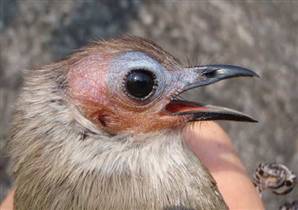
This bald-headed, pink-faced songbird was accidentally found by scientists who were surveying a limestone outcrop in Laos. Photo: Iain Woxvold, University of Melbourne
A bald-headed songbird with a pink, nearly featherless face and distinctive calls has just been found in a rugged region of Laos, according to scientists from the Wildlife Conservation Society and the University of Melbourne who made the discovery.
Aside from its unique characteristics, the avian is noteworthy because it is the only known bald songbird in Asia.
The find additionally marks the first description in over 100 years of a new Asian species of bulbul, since the songbird has been placed in that family of birds. This bulbul was named Pycnonotus hualon, with “hualon” being the Lao word for “bald-headed.”
For more, read here.
 About Loren Coleman
Loren Coleman is one of the world’s leading cryptozoologists, some say “the” leading living cryptozoologist. Certainly, he is acknowledged as the current living American researcher and writer who has most popularized cryptozoology in the late 20th and early 21st centuries.
Starting his fieldwork and investigations in 1960, after traveling and trekking extensively in pursuit of cryptozoological mysteries, Coleman began writing to share his experiences in 1969. An honorary member of Ivan T. Sanderson’s Society for the Investigation of the Unexplained in the 1970s, Coleman has been bestowed with similar honorary memberships of the North Idaho College Cryptozoology Club in 1983, and in subsequent years, that of the British Columbia Scientific Cryptozoology Club, CryptoSafari International, and other international organizations. He was also a Life Member and Benefactor of the International Society of Cryptozoology (now-defunct).
Loren Coleman’s daily blog, as a member of the Cryptomundo Team, served as an ongoing avenue of communication for the ever-growing body of cryptozoo news from 2005 through 2013. He returned as an infrequent contributor beginning Halloween week of 2015.
Coleman is the founder in 2003, and current director of the International Cryptozoology Museum in Portland, Maine.











It makes up its “follical shortcomings” in having a singing voice.
Cool.
As a “follically challenged person” myself (VERY, to be honest), I can totally relate. 🙂
Great Discovery. May it sings for centuries to come.
Am I the only one who thinks that this thing bears an uncanny [superficial] resemblance to a vulture?
Cool discovery, though.
I agree with CryptoInformant 2.0, although, if you read an article about the bird without a picture or a physical description, I wouldn’t picture something like a vulture.
It’s always cool when someone finds a new animal.
CryptoInformant 2.0: What would be interesting is finding out more about how this bird lives.
Vultures appear to have their featherless heads because plunging a headful of feathers into a carcass could be messy, even fatally so. That’s not so typical a feeding mechanism for songbirds, though, unless of course for this one, it is. Wouldn’t THAT be interesting.
Yes, i also wondered what the function is of the bald head. vultures, storks, and ibis all have varying degrees of bald-headedness. i researched and did not have much luck. some vultures may be related to storks. the wood stork is bald, but is not a big carrion eater to my knowledge. baldness can be a recent feature or a primitive feature.
Look at this thread about bald headedness in modern birds and Archaeopteryx.
I had a hard time following it, but maybe you can gleen something.
Maeko: interesting link. This is worth comment:
“The thing that bugs me about the often-stated idea that bald heads in birds are somehow a preferred adaptation for a scavenging lifestyle is that there isn’t a shred of evidence to support it. One, maybe two, taxa of large avian scavengers are bald, but the large majority of avians who scavenge for a living are not.”
Well, yeah. I did happen to think of crows and ravens, and how they don’t have bald heads.
(Oh. From what I hear it seems to be gaining scientific consensus that New World vultures, anyway, and storks are indeed related.)
Granted. “Evidence” isn’t simply “they scavenge and they have bald heads.” It is to me interesting though that the only birds – before this discovery, but then again maybe not! – that have bald heads do a lot of scavenging. It may be that corvids don’t have the need to plunge their heads into a carcass to get what they want from it. Vultures and condors are known to be very big eaters at carcasses; and as they tend to feed en masse, they can’t afford to be delicate. Also, the phrase “scavenge for a living” may need some review. Do corvids get *most* of their food scavenging? Or can they make do with foods that are also commonly eaten by perching birds? I frequently see them engaged in what appears to be just such activity. More often than I see them on dead animals.
I think, contrary to the bugged guy above, that regardless what one considers evidence backing the notion, there is much intuitive sense behind baldheadedness facilitating scavenging, and being selected for among birds that scavenge “for a living.”
Now another thing. This new bird doesn’t look like it has much neck to it. In other words, the feathers I see could get quite soily on a carcass.
But if we follow the evolutionary “rule” that adaptations selected for generally are so for a reason, well, scavenging is one that makes sense.