
Cryptic Cats Link Hostile Governments
Posted by: Loren Coleman on June 20th, 2008
It appears that elusive felines are behind a new bridge being built between two hostile governments. The governments, you ask? That would be Iran and the USA.
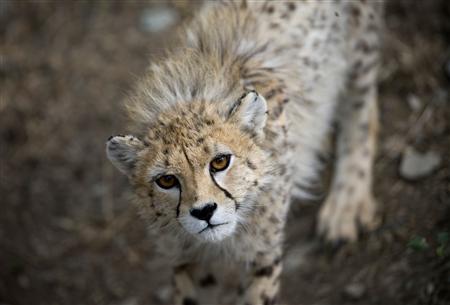
Iran is believed to host the only 60 – 100 Asiatic cheetahs left in the wild. Some eke out a living in a forbidding terrain of jagged peaks, deep gorges and bone-dry plains in the Kuh-e Bafgh protected area in Yazd province in central Iran.
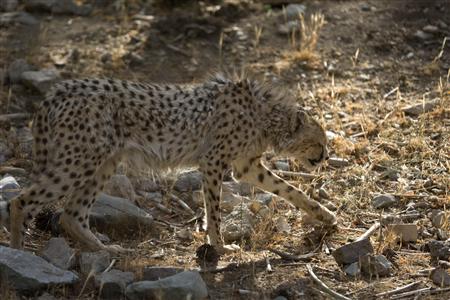
The sleek and spotted cats once roamed between the Arabian peninsula and India, but their number in Iran is estimated to have fallen by roughly half in the last three decades.
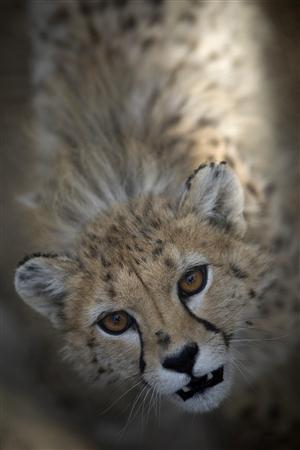
Kooshki, an Asiatic cheetah captured by a poacher as a cub and rescued by the Department of Environment, shown via these three photos, is in his enclosure at the Pardisan Zoo in Tehran on June 18, 2008.
Iranian and Western wildlife experts are working together to save rare cheetahs from extinction in this arid, mountainous region, despite a nuclear row between their governments.
For more see, here/Photos by Caren Firouz.
 About Loren Coleman
Loren Coleman is one of the world’s leading cryptozoologists, some say “the” leading living cryptozoologist. Certainly, he is acknowledged as the current living American researcher and writer who has most popularized cryptozoology in the late 20th and early 21st centuries.
Starting his fieldwork and investigations in 1960, after traveling and trekking extensively in pursuit of cryptozoological mysteries, Coleman began writing to share his experiences in 1969. An honorary member of Ivan T. Sanderson’s Society for the Investigation of the Unexplained in the 1970s, Coleman has been bestowed with similar honorary memberships of the North Idaho College Cryptozoology Club in 1983, and in subsequent years, that of the British Columbia Scientific Cryptozoology Club, CryptoSafari International, and other international organizations. He was also a Life Member and Benefactor of the International Society of Cryptozoology (now-defunct).
Loren Coleman’s daily blog, as a member of the Cryptomundo Team, served as an ongoing avenue of communication for the ever-growing body of cryptozoo news from 2005 through 2013. He returned as an infrequent contributor beginning Halloween week of 2015.
Coleman is the founder in 2003, and current director of the International Cryptozoology Museum in Portland, Maine.










Cool, I love how cheetahs look… What if animals in one country waged war on the same species of animals in another country?
Isn’t that what we are doing?? Who is the more intelligent animals??
man as just another animal, sometimes better, more often worse than those that walk on all-fours, who, because of his “divine spiritual and intellectual development,” has become the most vicious animal of all!
I’ve always been fascinated by the Asiatic cheetah. When people think of cheetahs, they always think of Africa, and very few even know that this type exists. Maybe this news will raise awareness of their plight. What a strikingly beautiful animal.
Do they glow in the dark?
Well, if these beautiful animals can help create bonds of cooperation between two enemy nations, the whole world will have much to thank them.
It seems to be more of a collaboration between “wildlife experts” from the two countries, rather than any high-level government initiatives. Unfortunately, regardless of their level of influence in certain areas of state policy, the wildlife experts generally are not the most “powerful” individuals in preventing decisions or actions (by either country) that may endanger the remaining Asiatic Cheetahs (as well as much more).