Almas vs Almasty
Posted by: Loren Coleman on April 30th, 2011
Have you ever wondered about the difference between Almas vs Almasty?
T. Peter Park writes:
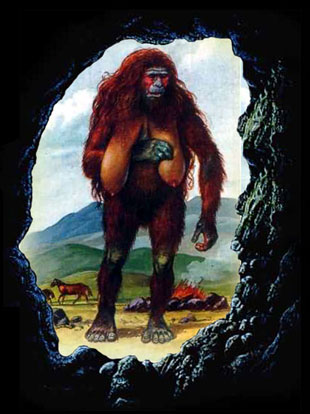
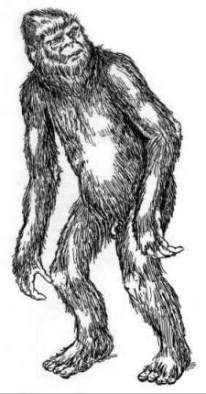
“The names Almas and Almasty have always puzzled me a bit. The Almas, according to all the references I’ve seen to it, is a hairy hominid of Mongolia, classified by you and Patrick Huyghe in The Field Guide to Bigfoot and Other Mystery Primates
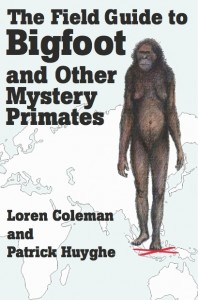
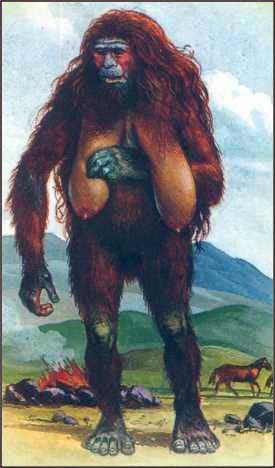
as a Homo erectus variant and by Myra Shackley in Still Living? as a Neandertal. The Almasty, as I seem to recall, is an alternative name, along with Gul-bi-Aban (“Desert Demon”), of the Kaptar of the Caucasus, which you and Patrick also described as a Homo erectus variant in The Field Guide to Bigfoot and Other Mystery Primates. The Almas and Almasty, with their very similar names, inhabit quite widely separated geographical areas, as mutually distant as Kansas and California, with also quite different local languages.
“The Almas inhabits a Mongolian-speaking region, with perhaps a little geographical overspill into neighboring areas speaking Chinese and/or Turkic languages like Uighur, Tuvinian, or Kirghiz. The Caucasus, home of Almasty/Kaptar/Gul-biaban, on the other hand, is divided between speakers of Caucasian languages like Georgian, Mingrelian, Cherkess, Chechen, Abkhaz, Adyghe, and Avar, Turkic languages like Azerbaijani, Nogay, and Kumyk, Iranian languages like Ossetic and Kurdish, and Armenian, an independent branch of Indo-European. Even in ancient times, the Caucasus was called the ‘Mountain of Tongues’ for its linguistic diversity. Turkic languages are spoken in both areas, but I gather that Almas is generally considered a native Mongolian word, and not a Turkic borrowing. One Mongolian dictionary I once consulted defined almas as the Mongolian word for ‘witch’! As for Gul-biban, that is an Iranian expression for ‘demon or ghoul of the wilderness.’
“As for the ‘other varied types of central and southern Asian hairy hominids that could be both Neandertals and Homo erectus varieties.’
“I recall from The Field Guide to Bigfoot and Other Mystery Primates that the Chinese yeren, literally ‘wild man’ or ‘forest man,’ is variously applied in China to Neandertals, to Homo erectus variants, and to unknown pongids, as a heterogeneous omnium gatherum similar to the American popular and journalistic (mis)use of ‘Bigfoot.'”
 About Loren Coleman
Loren Coleman is one of the world’s leading cryptozoologists, some say “the” leading living cryptozoologist. Certainly, he is acknowledged as the current living American researcher and writer who has most popularized cryptozoology in the late 20th and early 21st centuries.
Starting his fieldwork and investigations in 1960, after traveling and trekking extensively in pursuit of cryptozoological mysteries, Coleman began writing to share his experiences in 1969. An honorary member of Ivan T. Sanderson’s Society for the Investigation of the Unexplained in the 1970s, Coleman has been bestowed with similar honorary memberships of the North Idaho College Cryptozoology Club in 1983, and in subsequent years, that of the British Columbia Scientific Cryptozoology Club, CryptoSafari International, and other international organizations. He was also a Life Member and Benefactor of the International Society of Cryptozoology (now-defunct).
Loren Coleman’s daily blog, as a member of the Cryptomundo Team, served as an ongoing avenue of communication for the ever-growing body of cryptozoo news from 2005 through 2013. He returned as an infrequent contributor beginning Halloween week of 2015.
Coleman is the founder in 2003, and current director of the International Cryptozoology Museum in Portland, Maine.