
Nguoi Rung Reclaimed: Vietnam Vets’ Rock Ape Living History Project
Posted by: Loren Coleman on November 9th, 2011
It happened again last week. With the re-opening of the International Cryptozoology Museum, lots of new visitors came. One was a Vietnam vet who said he was “in country,” at a base, when many of his fellow soldiers would tell of their dusk encounters with the “Rock Apes.” The Vietnamese called them the “Nguoi Rung.”
The gentleman had no doubt that many more stories of the “rock apes” are out there among vets who have never talked about their sightings.
Due to conversations with this veteran and others, the International Cryptozoology Museum, for Veterans Day 2011, is announcing the creation, development, and ongoing “living history project” to gather Vietnam Veterans (of all countries) stories, writings, books, and encounter remembrances of the Rock Apes.

An artist conception of the Nguoi Rung, the Vietnamese name for the Rock Ape.
Last March came yet another confirmation left by a Cryptomundian identifying himself as “VietVet”:
In country, 65-66, 70-71, 71-72.
Rock Ape sightings. Central highlands and up.
Humped jungle in line plt. (squad size 6-10) and of course Recon and LLRPS.Your sightings were more likely from out in the bush (infantry) and not base camp, better known as (REMF’S).
Sightings limited for reason of proximity and location, not to mention reports.
Example the RTO gets on the horn and our Lt. reports to the commander, “Enemy contact 3 kia’s. NVA or VC?”
“No we killed 3 rock apes.”
“Don’t the damn fools know the difference between the enemy and a bunch of monkeys.”Looks nice on a sitrat (situation report), doesn’t it?
A lot happens and [is] never reported and/or not considered significant, especially in a war zone.Yes, they are real; how do I know?
I saw them and I say they are real; big deal, don’t mean nothin’.
VietVet

In the book, Very Crazy GI – Strange but True Stories of the Vietnam War, Vietnam War veteran Kregg P. J. Jorgenson tells of how he had an actual sighting of a short, red-haired, hairy, upright anthropoid, which he says soldiers in Vietnam called a “Rock Ape.” One even was said to be captured in Dak Lak Province in 1971, and in 1974 a North Vietnamese general, Hoang Minh Thao, requested an expedition to find evidence of the creatures, but it was unsuccessful.
Other soldiers, we are told, down through the years, have told of their own Vietnam War era encounters with these cryptids.
Incidents are to be found on the Internet, such as this one here:
All except one was light brown to reddish brown in color, and about 3 1/2 four feet tall. One dark, almost black, male remained fighting to protect the others retreat and he was flying through the branches and rushing the men with his teeth bared. He was one very brave animal, I’ll tell you that. Michael Kelley
And here:
When Poncho got control of himself, he told me that he had been walking back to the bunker when he noticed a bush that hadn’t been there before. He bent over to see it better and it SNORTED at him and he fired. What he had encountered was the ubiquitous Rock Ape of Vietnam. I would come to learn that they were nearly everywhere, and quite fearless. That is what we had heard near the wire that night.Robert “JungleVet” Baird
Names like “Monkey Mountain” apparently referred not to local monkeys but to the Rock Apes.
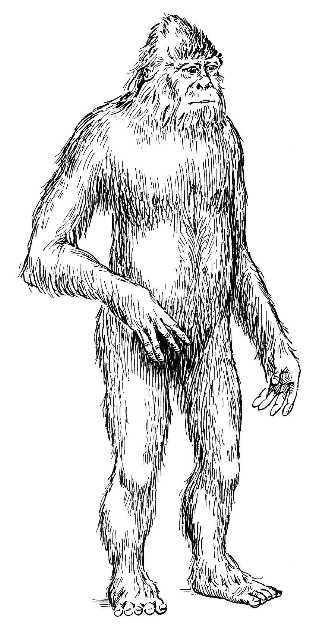
Nguoi Rung
Source: The Field Guide to Bigfoot and Other Mystery Primates
 About Loren Coleman
Loren Coleman is one of the world’s leading cryptozoologists, some say “the” leading living cryptozoologist. Certainly, he is acknowledged as the current living American researcher and writer who has most popularized cryptozoology in the late 20th and early 21st centuries.
Starting his fieldwork and investigations in 1960, after traveling and trekking extensively in pursuit of cryptozoological mysteries, Coleman began writing to share his experiences in 1969. An honorary member of Ivan T. Sanderson’s Society for the Investigation of the Unexplained in the 1970s, Coleman has been bestowed with similar honorary memberships of the North Idaho College Cryptozoology Club in 1983, and in subsequent years, that of the British Columbia Scientific Cryptozoology Club, CryptoSafari International, and other international organizations. He was also a Life Member and Benefactor of the International Society of Cryptozoology (now-defunct).
Loren Coleman’s daily blog, as a member of the Cryptomundo Team, served as an ongoing avenue of communication for the ever-growing body of cryptozoo news from 2005 through 2013. He returned as an infrequent contributor beginning Halloween week of 2015.
Coleman is the founder in 2003, and current director of the International Cryptozoology Museum in Portland, Maine.










I’ve posted on this before, but thought it was worth mentioning again. My father, who was a member of Force Recon at the time, mentioned that they encountered a number of these when originally securing the infamous “Rockpile” of Marine lore – before this became an observation and artillery base, it was originally used as a sniper’s post. He said that there were many of these creatures living midway up the mountain, and possibly inside it. Before my father’s group decided to land by helicopter on top of the mountain, they had thought about climbing to the top instead, but decided against it as the majority of the area was covered in monkey feces, which unfortunately made for great infections.
I’ll mention to him that this topic was brought up again on your site, as he was pretty excited to hear that people were talking about it back in March.
Probably worth saying again what I’ve said each time I’ve seen this topic come up previously:
Americans in Vietnam with no jungle experience probably wouldn’t have been surprised to see man-size centipedes or giant pterosaurs. This probably largely accounts for the apparent nonchalance of a number of these reports.
Keep in mind that the saola, a 300-pound bovid living in this region, wasn’t confirmed until almost two decades after the last US troops left.
If the orang pendek, sasquatch and yeti deserve attention from science, this does too.
Good stuff!
Hmmm…
Vietnamese Rare Gibbon?
I think that too many individuals that are essentially unaware of the known fauna from regions that are relatively exotic pass off sightings that would never cease to fascinate mainstream zoologists as the unusual, but taxonomically recognized, animals. It seems pertinent to point out that nearly all evidence for nguoi rung is strictly testimonial. I think this is largely because of the unfamiliarity of American residents while in Vietnam.
I understand and appreciate kryptos006’s point but, of course, the term nguoi rung undermines the argument. While Americans called these cryptid primates “Rock Apes,” the use of nguoi rung by the locals reflects the native eyewitness experiences with this unknown animal.
I actually don’t think that kryptos006’s point and the ethnoknown nature of the animal are mutually exclusive.
The saola was obviously long ethnoknown, but I didn’t have an inkling until I heard of the Western research efforts a couple years or so before the actual confirmation. I wouldn’t expect saola to have been high up on the priority list of the American military in Vietnam, regardless whether they heard stories or not; and I think nguoi rung falls into the same category. Namely: ethnoknown, but not part of the society-at-large’s knowledge (as witness the North Vietnamese expedition).
I think the point is valid (and it’s the same as mine): Americans saw this as sort-of-expected, and had other priorities, so, well, here we are.
I feel that it is relevant to point out the case of the discovery of the mountain gorilla despite its geographic irrelevancy to nguoi rung. If you recall, natives had known about this great ape known as ngila for centuries. These selfsame natives mentioned the ngila to as many foreign travelers as was possible and yet this African “man-ape’s” status of existence remained unknown. Nevertheless, the creature was not actually living sub rosa as is often suggested. It was ethnoknown, but testimonies were not the only evidence that suggested its existence. Ewart Grogan discovered a ngila skeleton in 1899, but, like other evidence that is attributed to cryptids, it was lost. The problem I have with the nguoi rung is that, with the mystery of Sasquatch being so prevalent in North America, one might assume that a similar creature would be notable to American soldiers. Assuming this is accurate, which it is according to the above article, then the question of why there has not been any physical evidence presented for the nguoi rung is inevitable. As Matthew Bille said in a comment from a past Cryptomundo post, “the evidence for the nguoi rung is strictly circumstantial.” Am I missing a piece of the puzzle, because if I am, please fill me in.
I served as an Airborne Infantry Squad leader with the 101st Airborne in 1968 and 1969. My primary area of operation was from the Hai Van pass north of Danang to the southern edge of Hue and west to Laos including the Ashau valley. I saw numerous brown and reddish brown rock apes during that time. Many were in excess of 4 ft. and up to 300 lbs. They likely were never killed as silence was the rule in the jungle and it was imperative that we did no give away our position for fear of ambush,, mortars or, in the case of the Ashau valley, artillery rounds from neighboring Laos. Higher up wanted confirmed body counts not crypto sightings. Many rock ape sightings were unreported. This was a dense jungle in which encounters with Tigers, elephants, small monkeys, bamboo vipers, banded kraits and king Cobras occurred on occasions.